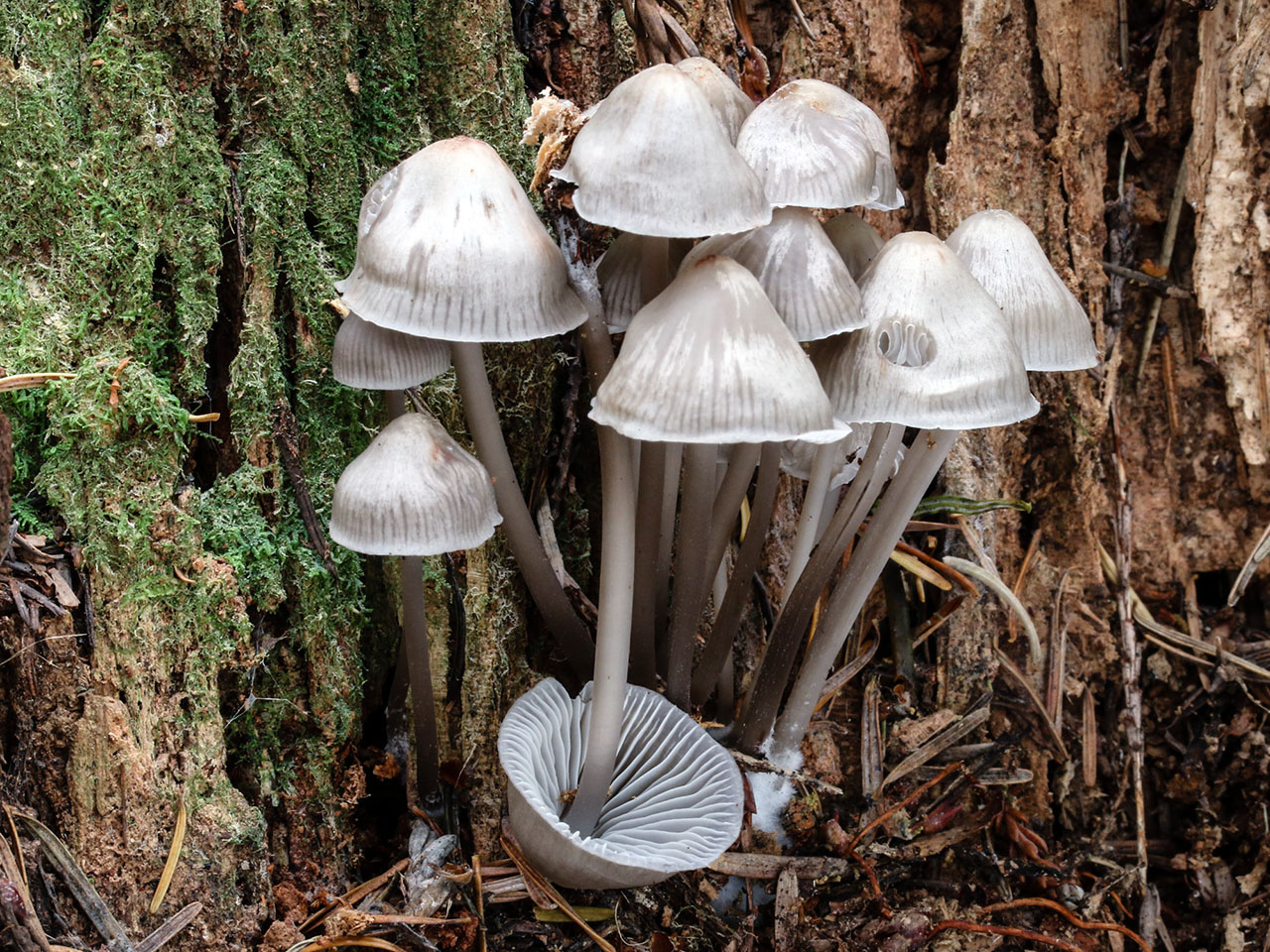
Mycena maculata
Meddn Soc. Fauna Flora fenn. 19: 89. 1890.
Common Name: none
Pileus 1.5-4.0 cm broad, obtuse-conic to broadly conic-umbonate, becoming campanulate to convex-umbonate, in age plano-convex, a low umbo often persisting; margin incurved in youth, then decurved, entire to obscurely crenate or eroded at maturity; surface oily when moist, otherwise dry, not hygrophanous, striate to striate-sulcate approximately one-half the distance to the disc, elsewhere glabrous; color when fresh, greyish-brown fading to pale-grey or buff-brown, frequently developing sordid reddish-brown spots; context thin, approximately 1 mm at the disc, white, sometimes discoloring reddish-brown where cut or injured; odor not distinct, taste slightly of cucumbers.
Gills broadly notched to subdecurrent, fairly well-spaced, thin, ventricose, intervenose, pallid when young, becoming pale-grey, occasionally slightly pinkish, often developing reddish-brown spots on the gill faces, not marginate; lamellulae up to 3-seried.
Stipe 2-9 cm long, 1.5-4.0 mm thick, straight to curved at the base, equal, somewhat flattened in cross-section, cartilaginous, hollow to stuffed at maturity; surface of apex glabrous, lustrous, pallid, the lower portion greyish-buff, indistinctly striate to twisted-striate, sometimes spotted reddish-brown, a dense covering of whitish hairs at the base, the latter well developed, growing into the substrate, not bleeding a reddish juice; partial veil absent.
Spores 7.5-9.5 x 5.0-5.5 µm, ellipsoid, smooth, thin-walled, amyloid, hilar appendage conspicuous, contents granular with one to several vacuolar inclusions; spore print white.
Gregarious to clustered, mostly on conifer stumps and logs; fruiting from late fall to mid-winter.
Unknown, insignificant.
Reddish-brown discolorations and clustered fruitings on conifer wood are hallmarks of this common Mycena. Several other lignicolous Mycenas resemble it including Mycena purpureofusca, M. galericulata, and M. haematopus. Mycena purpureofusca is distinguished by a vinaceous-purple cap, vinaceous-edged (marginate) gills, and tendency to fruit on pine cones. Mycena galericulata is similar in color but does not develop reddish-brown spots. Additionally, it typically is larger and has a preference for hardwoods. Most likely to be confused with Mycena maculata is M. haematopus. In age this Mycena may also develop reddish-brown areas on the cap, but can be recognized by a crenate cap margin, stipe which bleeds a reddish juice, and a hardwood habit.
Aronsen, A. & Læssøe, T. (2016). The Genus Mycena s.l. Danish Mycological Society: Copenhagen, Denmark. 373 p.
Breitenbach, J. & Kränzlin, F. (1991). Fungi of Switzerland. Volume 3: Boletes and Agarics (1st Part). Strobilomycetaceae, Boletaceae, Paxillaceae, Gomphidiaceae, Hygrophoraceae, Tricholomataceae, Polyporaceae (lamellate). Verlag MykoArora, D. (1986). Mushrooms Demystified. Ten Speed Press: Berkeley, CA. 959 p.logia: Luzern, Switzerland. 361 p.
Desjardin, D.E., Wood, M.G. & Stevens, F.A. (2015). California Mushrooms: The Comprehensive Identification Guide. Timber Press: Portland, OR. 560 p.
Knudsen, H. & Vesterholt, J. ed. (2008). Funga Nordica: Agaricoid, boletoid and cyphelloid genera. Nordsvamp: Copenhagen, Denmark. 965 p. (PDF)
Knudsen, H. & Vesterholt, J. ed. (2012). Funga Nordica: Agaricoid, boletoid, clavarioid, cyphelloid and gastroid genera. Vol. 1. Nordsvamp: Copenhagen, Denmark. 511 p.
Mass Geesteranus, R. A. (1992). Mycenas of the Northern Hemisphere. II. Conspectus of the Mycenas of the Northern Hemisphere. Koninklijke Nederlandse Akademie van Vetenschappen: Amsterdam, Netherlands. 493 p.
Perry, Brian A. (2002). A Taxonomic Investigation of Mycena in California. Masters Thesis, San Francisco State University: San Francisco, CA. 157 p. (PDF)
Robich, Giovanni (2003). Mycena D'Europa. Associazione Micologica Bresadola: Trento, Italy. 728 p.
Siegel, N. & Schwarz, C. (2016). Mushrooms of the Redwood Coast. Ten Speed Press: Berkeley, CA. 601 p.
Smith, Alexander H. (1947). North American Species of Mycena. University of Michigan Press: Ann Arbor, MI. 521 p. (PDF)