Mycena galericulata
Nat. Arrang. Br. Pl. 1: 619. 1821.
Common Name: none
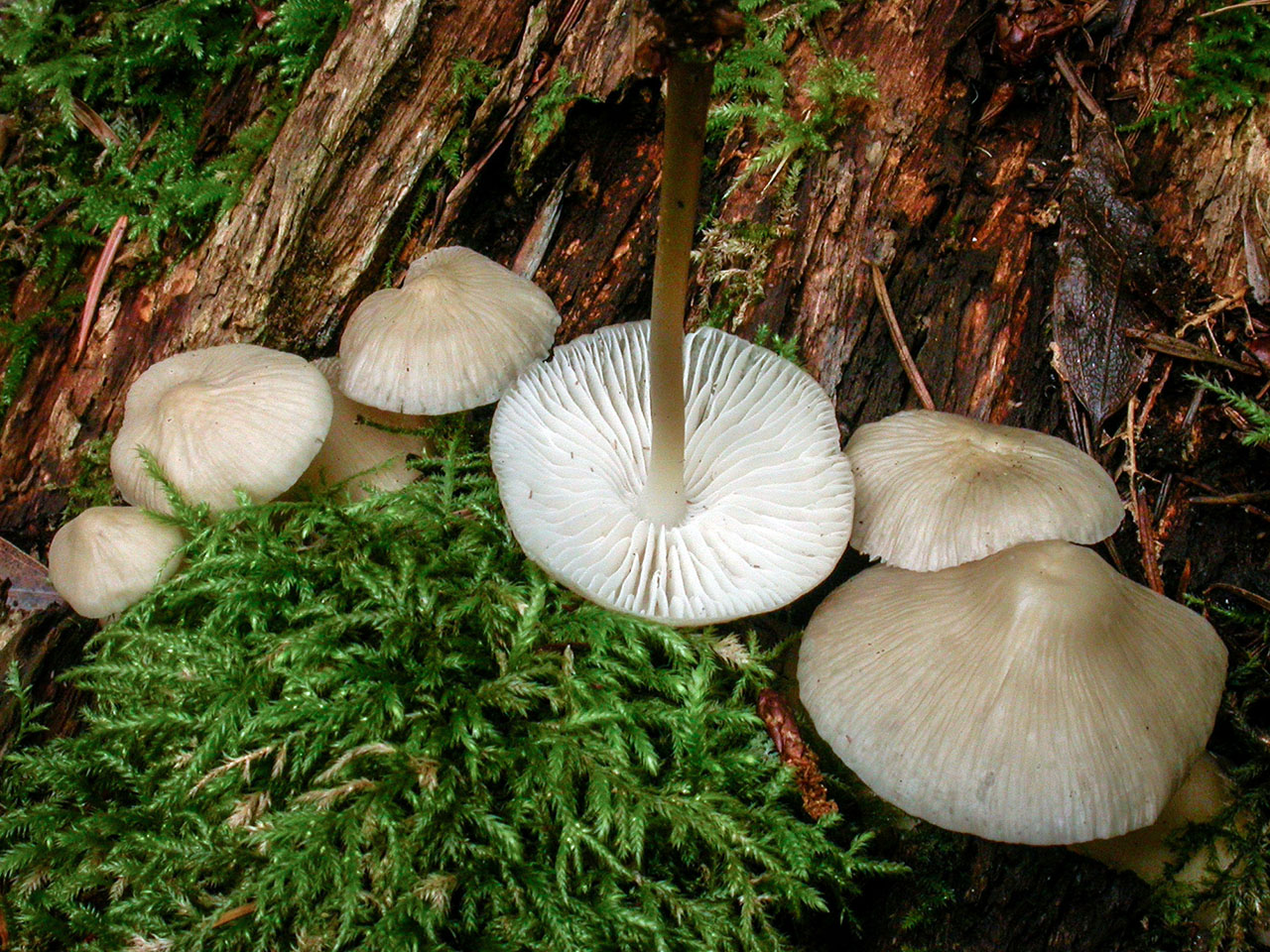
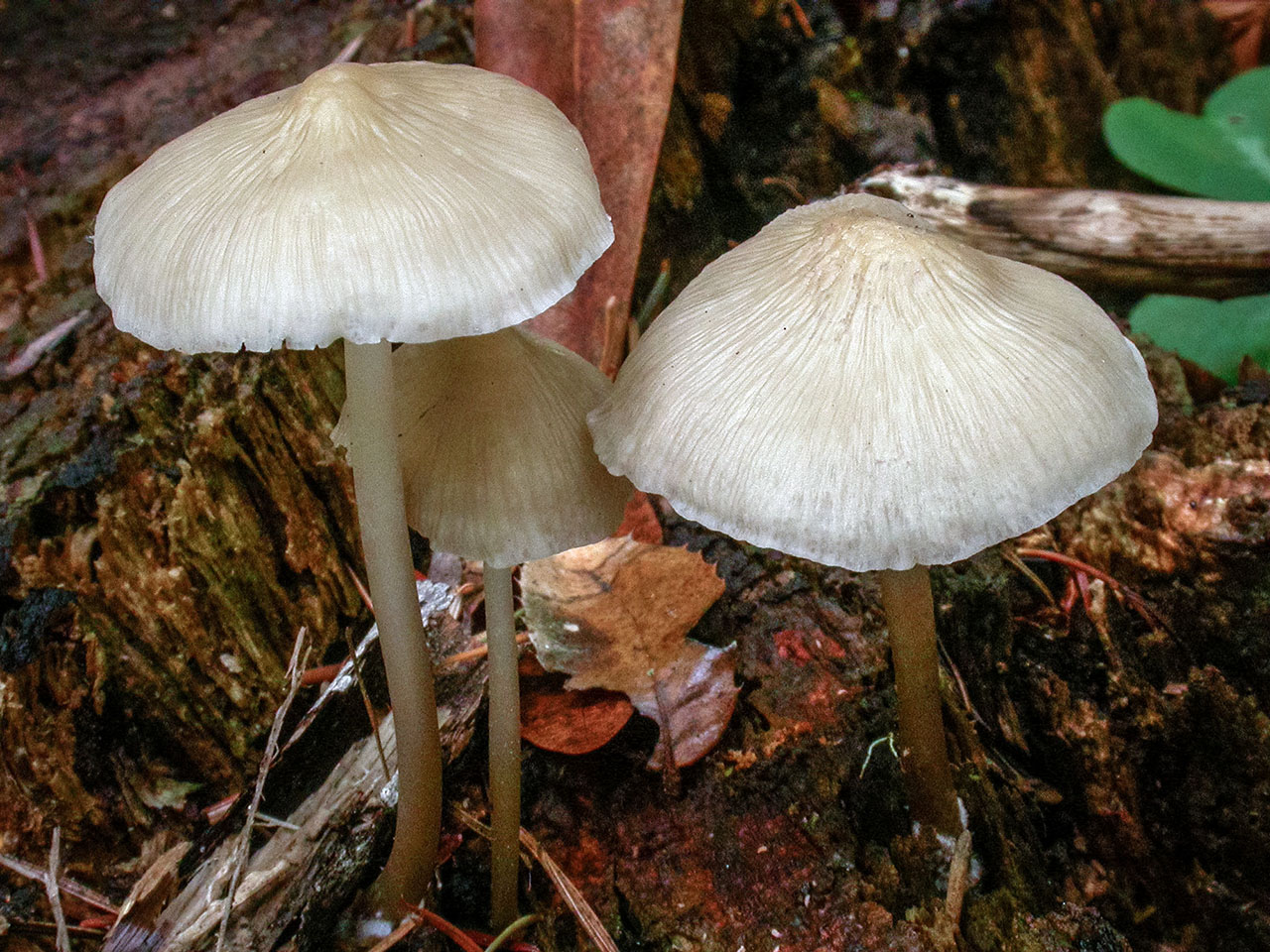
Cap 2.0-5.0 cm broad, obtuse-conic to bell-shaped, expanding to plano-convex, sometimes plano- depressed; margin incurved, then decurved, eventually plane to raised, occasionally wavy; surface moist, striate-wrinkled to near the disc at maturity, color: buff-brown, tan-brown, pale brownish-grey, the margin lighter than the disc, darker overall with age; context white, unchanging, thin, up to 2.5 mm at the disc; odor and taste farinaceous.
Gills adnexed to notched with a decurrent tooth, close when young, subdistant at maturity, ventricose, up to 8.0 mm wide, intervenose, pallid to white in youth, pale-grey to buff-brown in age, sometimes tinged pinkish, lamellulae up to 4-seried, edges smooth, not marginate.
Stipe 3-14 cm long, 2.0-5.0 mm thick, more or less equal, slender, often sinuose, stuffed to hollow, cartilaginous; surface glabrous when young, becoming appressed-striate to twisted-striate, hairy at the base, the latter root-like and prolonged into the substrate; color pallid to cream at the apex, lower portion cream-buff to light-brown, dull grey-brown in some specimens, especially near the base; partial veil absent.
Spores 8.5-10.5 x 6.0-7.5 µm, broadly ellipsoid to ovoid, smooth, thin-walled, hilar appendage conspicuous, amyloid; spore print white.
Scattered to clustered on hardwood logs and stumps; fruiting from after the fall rains to mid-winter.
 Edible, but untried locally.
One of the larger members of the genus, Mycena galericulata is recognized by a pale-brown, striate-wrinkled cap, clustered habit on decaying hardwood logs, and a rooting, hairy stipe. It is most likely to be confused with two other wood-rotting Mycenas, M. maculata and M. haematopus. Mycena maculata is similarly colored and equally common, but can be distinguished by sordid reddish-brown discolorations which develop in age. Mycena haematopus differs in having a vinaceous-brown cap with a minutely scalloped margin, and has a stipe that bleeds reddish-brown juice when injured.
Aronsen, A. & Læssøe, T. (2016). The Genus Mycena s.l. Danish Mycological Society: Copenhagen, Denmark. 373 p.
Arora, D. (1986). Mushrooms Demystified. Ten Speed Press: Berkeley, CA. 959 p.
Breitenbach, J. & Kränzlin, F. (1991). Fungi of Switzerland. Volume 3: Boletes and Agarics (1st Part). Strobilomycetaceae, Boletaceae, Paxillaceae, Gomphidiaceae, Hygrophoraceae, Tricholomataceae, Polyporaceae (lamellate). Verlag Mykologia: Luzern, Switzerland. 361 p.
Desjardin, D.E., Wood, M.G. & Stevens, F.A. (2015). California Mushrooms: The Comprehensive Identification Guide. Timber Press: Portland, OR. 560 p.
Knudsen, H. & Vesterholt, J. ed. (2008). Funga Nordica: Agaricoid, boletoid and cyphelloid genera. Nordsvamp: Copenhagen, Denmark. 965 p. (PDF)
Knudsen, H. & Vesterholt, J. ed. (2012). Funga Nordica: Agaricoid, boletoid, clavarioid, cyphelloid and gastroid genera. Vol. 1. Nordsvamp: Copenhagen, Denmark. 511 p.
Mass Geesteranus, R. A. (1992). Mycenas of the Northern Hemisphere. II. Conspectus of the Mycenas of the Northern Hemisphere. Koninklijke Nederlandse Akademie van Vetenschappen: Amsterdam, Netherlands. 493 p.
Perry, Brian A. (2002). A Taxonomic Investigation of Mycena in California. Masters Thesis, San Francisco State University: San Francisco, CA. 157 p. (PDF)
Robich, Giovanni (2003). Mycena D'Europa. Associazione Micologica Bresadola: Trento, Italy. 728 p.
Siegel, N. & Schwarz, C. (2016). Mushrooms of the Redwood Coast. Ten Speed Press: Berkeley, CA. 601 p.
Smith, A.H. (1947). North American Species of Mycena. University of Michigan Press: Ann Arbor, MI. 521 p.
Smith, A.H. (1949). Mushrooms in their Natural Habitats. Sawyer's Inc: Portland, OR. 626 p. (PDF)