Tricholoma muricatum
Mycologia 88(3): 507-508. 1996.
Common Name: none
Misapplied name: Tricholoma pessundatum
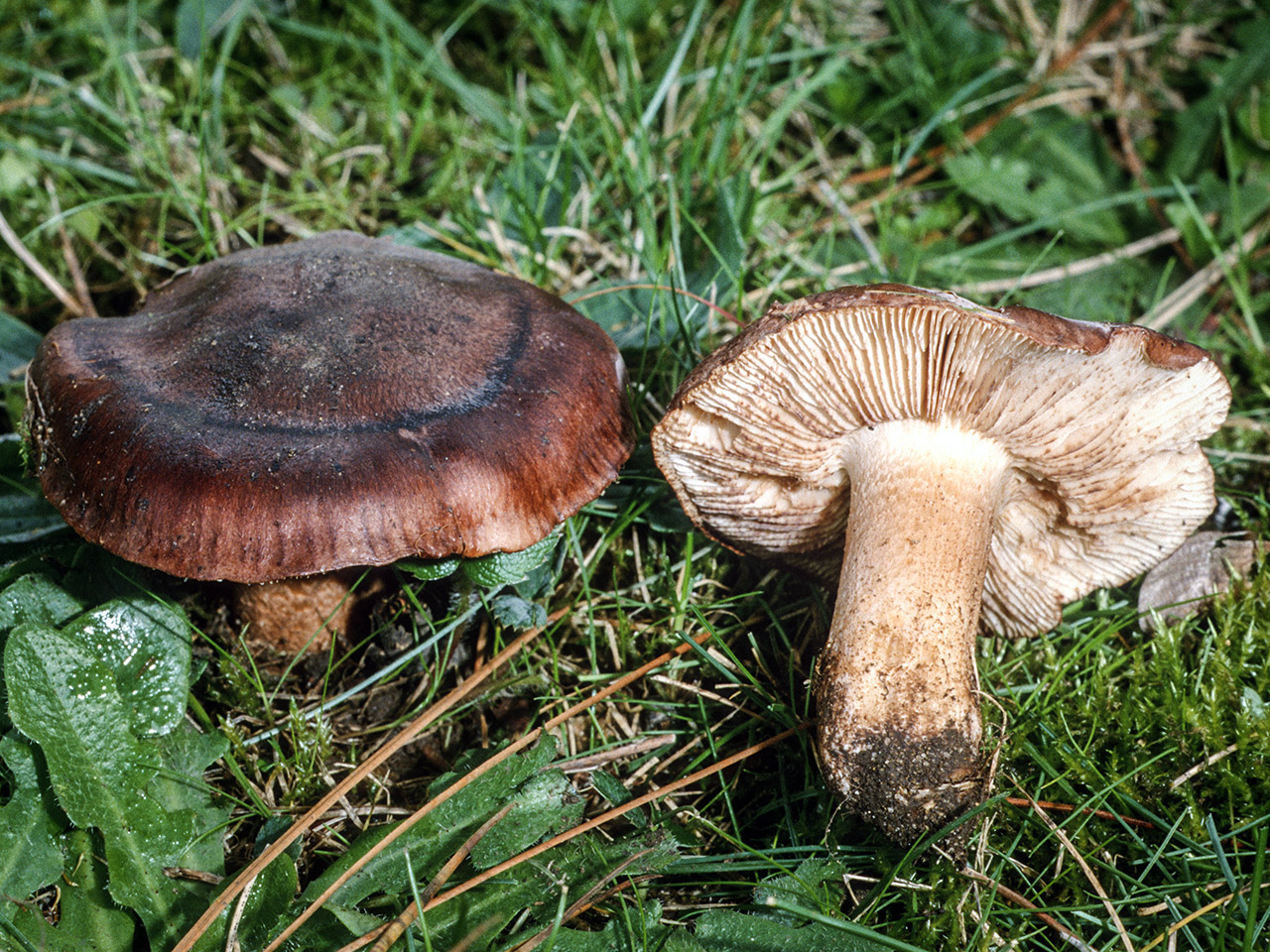
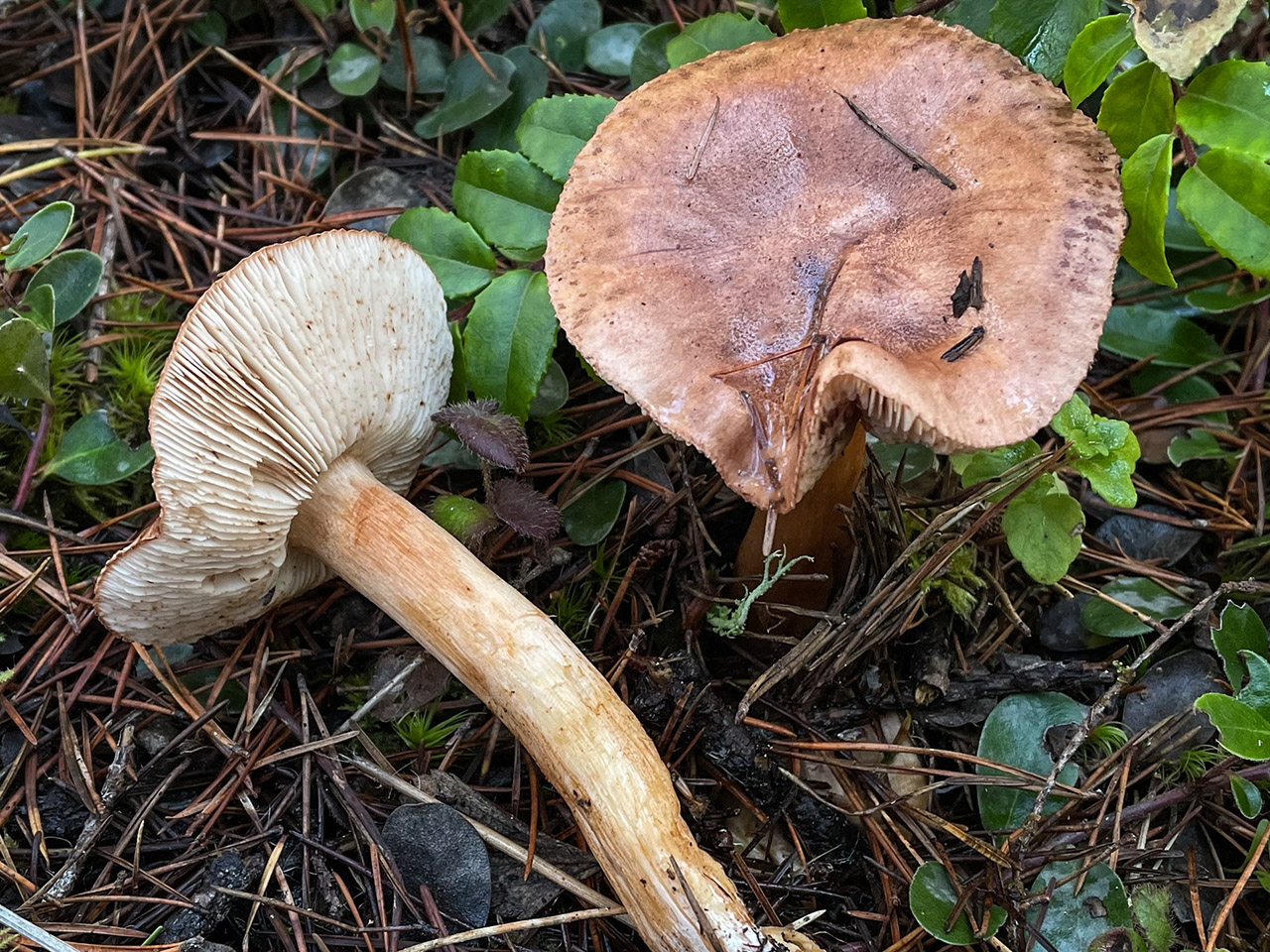
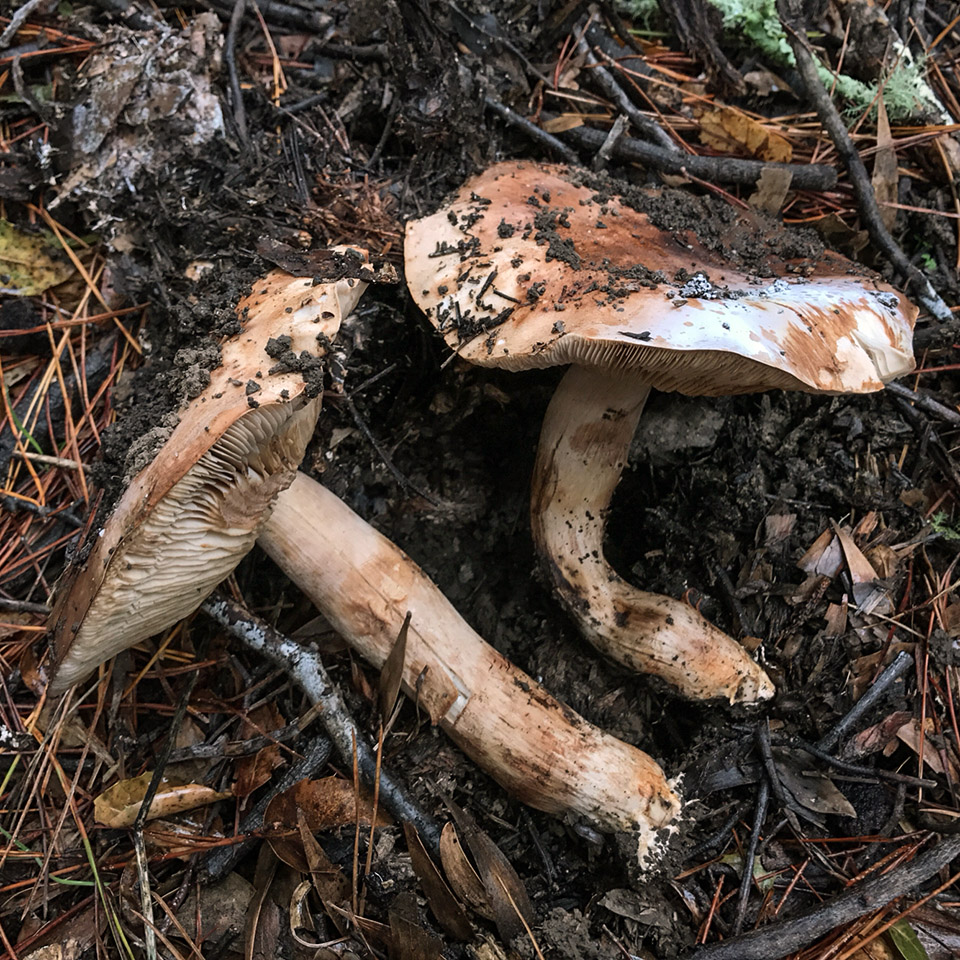
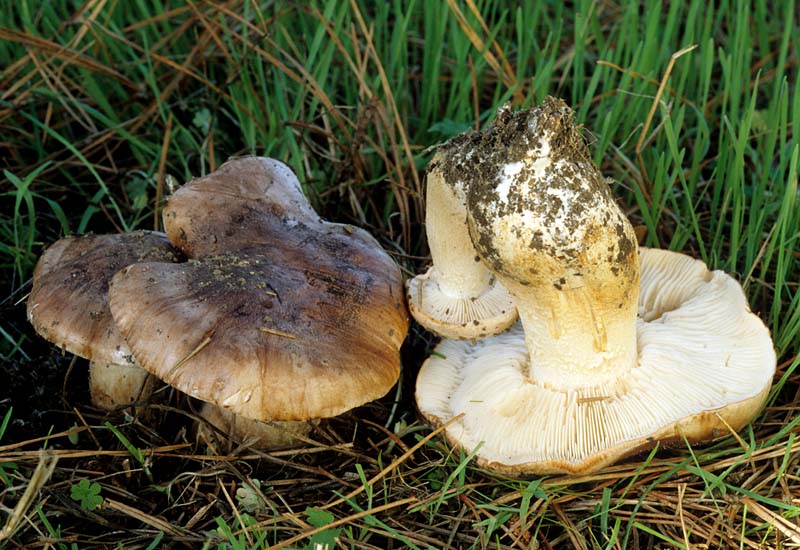
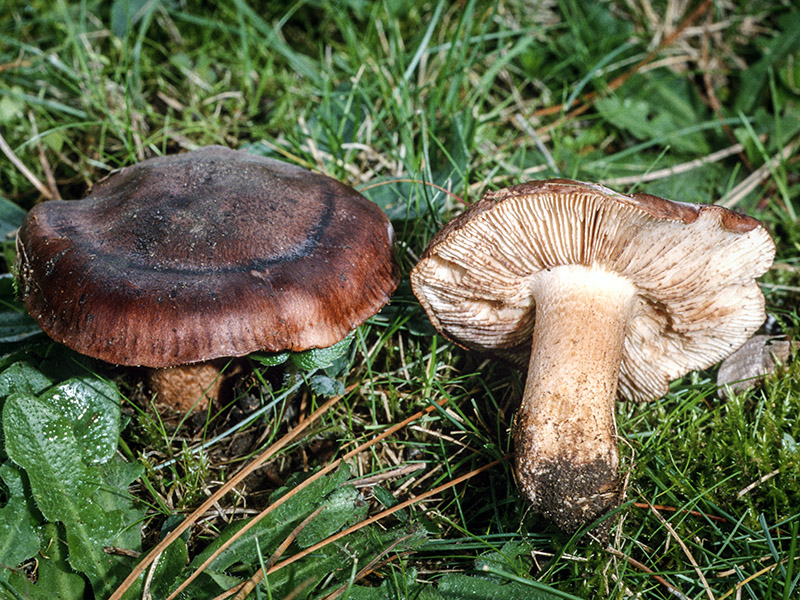
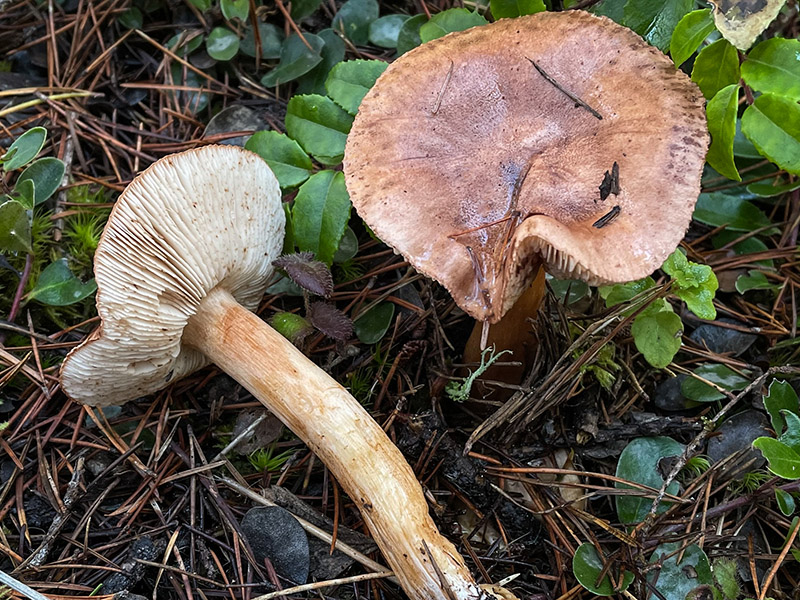
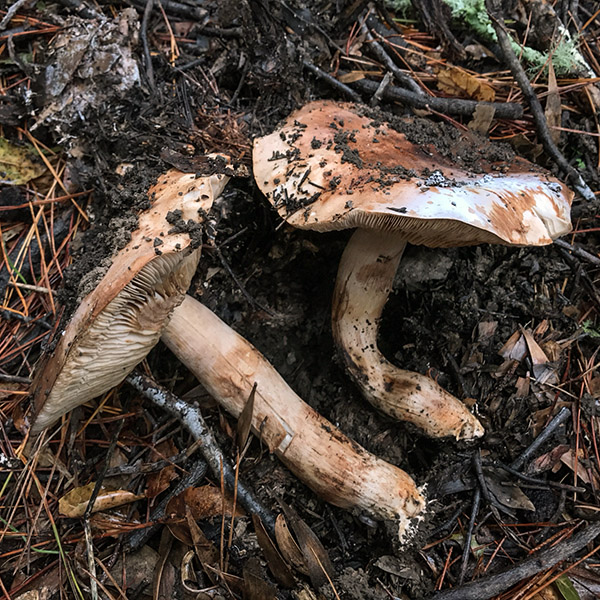
Cap 5-12 cm broad, convex, expanding to nearly plane, often with a low umbo; margin inrolled, wavy, becoming decurved to nearly plane, frequently striate in age; surface viscid when moist, appressed fibrillose, brown to reddish-brown, darkest at the disc, slightly lighter at the margin; flesh thick, firm, pallid, unchanging; odor and taste farinaceous.
Gills adnexed, notched to arcuate, close, moderately broad, cream-colored, becoming pale-buff, the edges often developing brownish discolorations.
Stipe 3-6 cm tall, 1-3.5 cm thick, stuffed to hollow at maturity, variable in shape: equal, narrowed to enlarged at the base, sometimes appearing clavate; surface pruinose or ridged from gill edges at the apex, cream-colored, elsewhere covered with appressed fibrils, buff-brown, discoloring darker brown from handling or in age; veil absent.
Spores 4.5-6 x 3-3.5 µm, elliptical, smooth, thin-walled, nonamyloid; spore print white.
Scattered to gregarious under pines, especially Monterey pine (Pinus radiata) and Bishop pine (Pinus muricatum); fruiting from early to mid-winter.
Possibly toxic.
For many years this Tricholoma was known as T. pessundatum, a European species. Kris Shanks has shown, however, that our local material has larger spores and a pileipellis that differs microscopically, thus worthy of species distinction. Tricholoma muricatum, is characterized by a brown to dark reddish-brown, viscid cap, the margin often striate at maturity, a strong, farinaceous odor, and gills that become mottled brown, especially the edges. It is most likely to be confused with Tricholoma fracticum, another dark reddish-brown, viscid species, but the latter forms a conspicuous dark annular line on the stipe, seldom has a striate margin, and lacks a strong farinacous odor. Another pine-dweller common in our area is Tricholoma imbricatum. It is similarly colored but can be distinguished by a dry, not visicd, fibrillose cap and usually mild odor.
Arora, D. (1986). Mushrooms Demystified. Ten Speed Press: Berkeley, CA. 959 p.
Bessette, A.E., Bessette, A.R., Roody, W.C. & Trudell, S.A. (2013). Tricholomas of North America. University of Texas Press: Austin, TX. 208 p.
Desjardin, D.E., Wood, M.G. & Stevens, F.A. (2015). California Mushrooms: The Comprehensive Identification Guide. Timber Press: Portland, OR. 560 p.
Shanks, Kris M. (1994). A Sytematic Study of Tricholoma in California. Masters Thesis, San Franciso State University: San Francisco, CA. 207 p. (PDF)
Shanks, Kris M. (1996). New species of Tricholoma from California and Oregon. Mycologia 88: 497-508. (Protologue) (PDF)
Shanks, Kris M. (1997). The Agaricales (Gilled Fungi) of California. 11. Tricholomataceae II. Tricholoma. Mad River Press: Eureka, CA. 54 p.
Siegel, N. & Schwarz, C. (2016). Mushrooms of the Redwood Coast. Ten Speed Press: Berkeley, CA. 601 p.
Trudell, S.A., Matheny, P.B., Parker, A.D., Gordon, M., Dougil, D.B. & Cline, E.T. (2022). Pacific Northwest Tricholomas: Are We Using the Right Names? Self Published: Seattle, WA. 103 p.