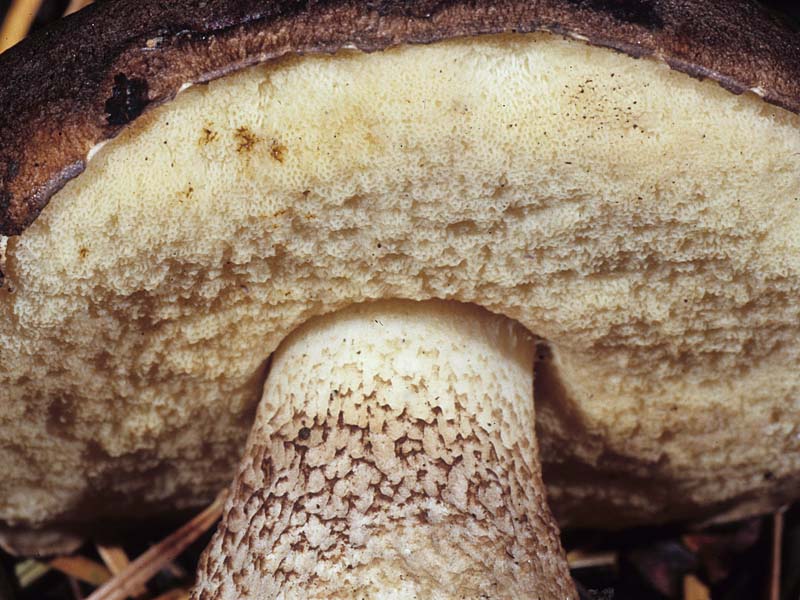
Leccinum brunneum
Mycologia 63: 269. 1971.
Common Name: none
For description see Thiers.
Scattered to gregarious in soil under aspens in riparian areas; uncommon, fruiting in fall at high elevations in the Sierra Nevada mountains.
 Edible.
Leccinum brunneum can be distinguished by a dark brown to brown, glabrous or finely subtomentose cap often fringed with a cuticular flap, white young pores that bruise brown, and a white stipe with brown scabers. Context tissues turn smoky gray when exposed, without first going to red. The species is known only from high elevations in the Sierra Nevada where it is mycorrhizal with aspen in the pine-fir zone. This habitat is home to the greatest diversity of Leccinum species in California, including Leccinum insigne, Leccinum discolor, Leccinum californicum, and Leccinum montanum. Leccinum insigne differs primarily in having a rusty brown to orangish brown cap and smaller spore. Leccinum discolor has a cinnamon-brown to auburn cap, and tissues stain red then grayish brown. Both L. californicum and L. montanum lack cuticular flaps on the cap margin; the former has a white to tan cap, the latter, a gray to grayish brown cap.
Bessette, A.E., Roody, W.C. & Bessette, A.R. (2000). North American Boletes: A Color Guide to the Fleshy Pored Mushrooms. Syracuse University Press: Syracuse, NY. 400 p.
Thiers, H.D. (1971). California Boletes. IV. The Genus Leccinum. Mycologia 63(2): 261-276. (Protologue)
Thiers, H.D. (1975). California Mushrooms--A Field Guide to the Boletes. Hafner Press: New York, NY. 261 p.