Gomphidius oregonensis
Bull. Torrey Bot. Club 25: 326. 1898.
Common Name: none
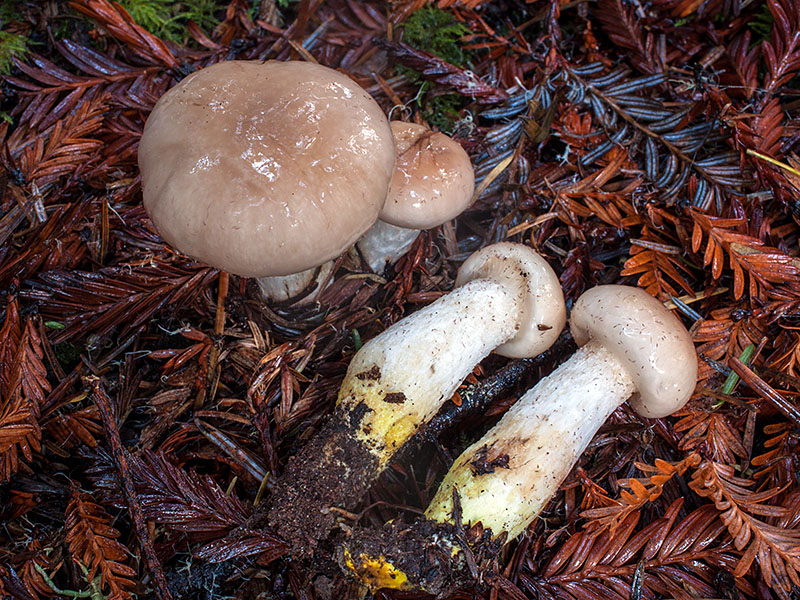
Cap 3-12 cm broad, convex, expanding to nearly plane, the disc sometimes depressed at maturity; margin incurved, then plane to uplifted; surface viscid to glutinous when wet, glabrous, color variable: when young, lilac-grey, pinkish-tan, salmon-buff, buff-brown, darkening in age and often developing blackish spots; context thick, soft, whitish, unchanging or darkening slightly when cut; odor and taste mild.
Gills decurrent, subdistant, moderately thick, at first pallid, becoming greyish-brown.
Stipe 5-11 cm long, 1.5-4.0 cm thick, solid, straight to curved, equal or tapered to a point; context firm, upper portion whitish, yellow at the base; apex surface moist, whitish, more or less glabrous, below the veil, pallid, moist, more or less glabrous, sometimes with secondary slime bands when young, the base bright yellow, in age often developing blackish spots; partial veil fibrillose with a glutinous lower layer, leaving a superior annular zone of fibrils and gluten, soon grey-brown from shed spores.
Spores 11-13.5 x 4.5-5 µm, narrowly ellipsoid to subfusoid, smooth, hilar appendage evident; spore print brownish-black.
Typically clustered but also solitary, in mixed hardwood/conifer woods; common under Douglas fir (Pseudotsuga menziesii); fruiting from early to mid-winter.
 Edible, but of little value, slimy.
This cousin of the common pine spike, Chroogomphus vinicolor, is recognized by a viscid to glutinous cap, often spotted black in age, conspicuously decurrent, gills, and a yellow stipe base. Gomphidius glutinosus is very similar but tends to be more solitary in its fruiting and has a stipe that is usually not as deeply buried in the substrate. A check of spore size, however, is often required to confirm an identification. Fortunately the spores of the two species are easily told apart, those of Gomphidius oregonensis several microns shorter than G. glutinosus. Another species found in our area, Gomphidius subroseus, has a cap, which as the species name suggests, has rose-pink tones.
Arora, D. (1986). Mushrooms Demystified. Ten Speed Press: Berkeley, CA. 959 p.
Desjardin, D.E., Wood, M.G. & Stevens, F.A. (2015). California Mushrooms: The Comprehensive Identification Guide. Timber Press: Portland, OR. 560 p.
Kauffman, C.H. (1925). The Genus Gomphidius in the United States. Mycologia 17(3): 113-126.
Miller Jr., O.K. (1971). The genus Gomphidius with a revised description of the Gomphidiaceae and a key to the genera. Mycologia 63(6): 1129-1163.
Miller Jr., O.K. (2003). The Gomphidiaceae revisited: a worldwide perspective. Mycologia 95(1): 176-183.
Peck, C.H. (1898). New species of fungi. Bull. Torrey bot. Club 25(6): 321-328. (Protologue)
Siegel, N. & Schwarz, C. (2016). Mushrooms of the Redwood Coast. Ten Speed Press: Berkeley, CA. 601 p.
Singer, R. (1949). The genus Gomphidius Fries in North America. Mycologia 41: 462-489.