 `
`
Choiromyces alveolatus
Mycotaxon 2(1): 114. 1975.
Common Name: none
Basionym: Piersonia alveolata Harkn. (Protologue)
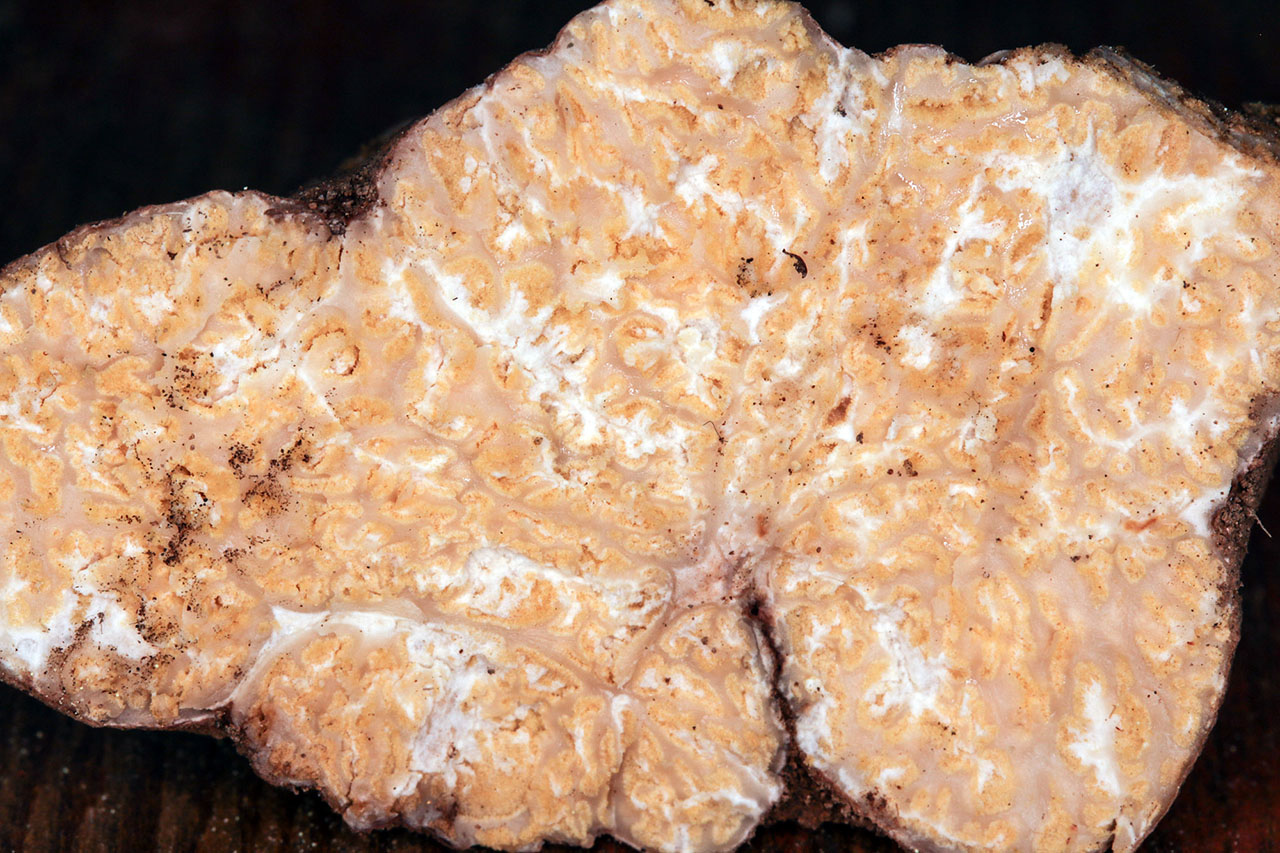
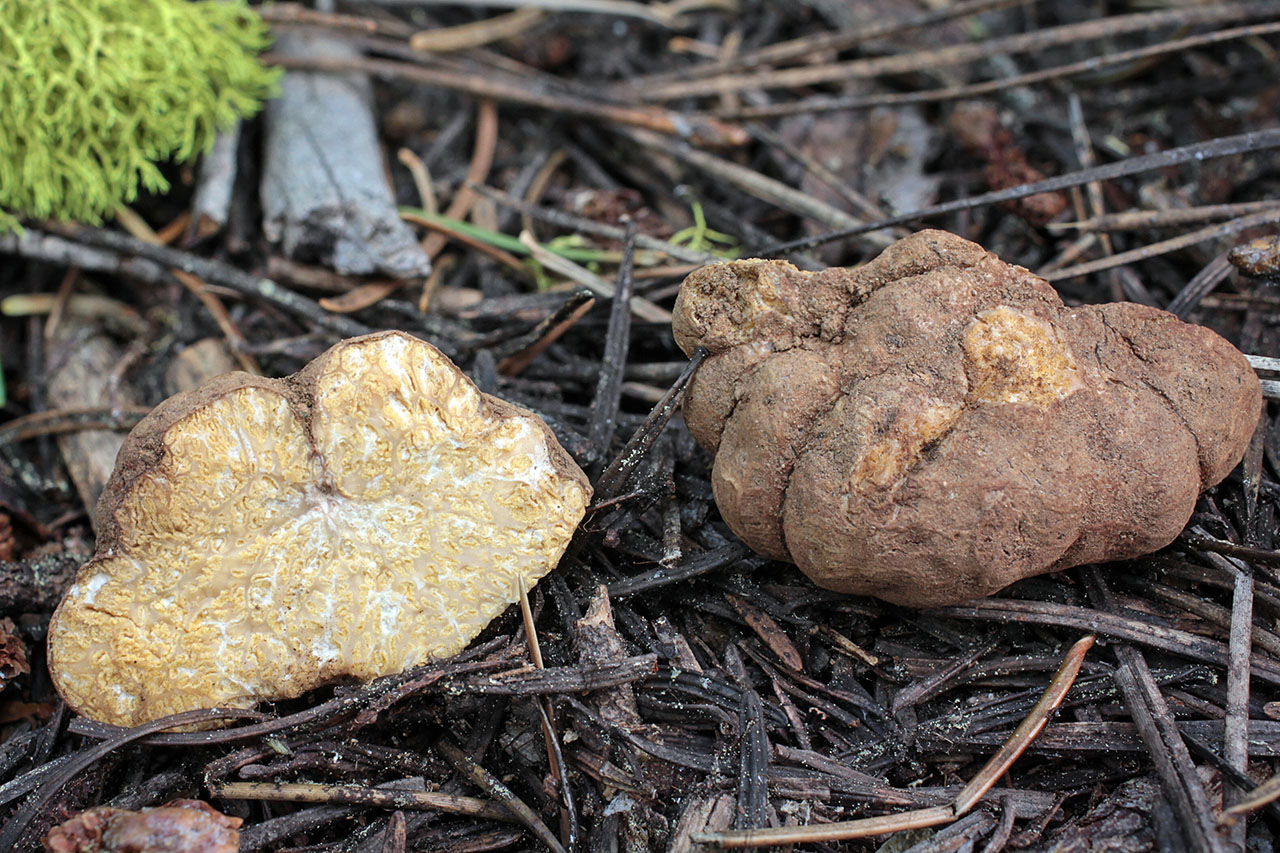
Ascocarp hypogeous, 20-80 mm broad, subglobose to pulvinate, knobby with folds, occasionally lobed, lacking a basal tuft of mycelium; peridium thin, felty to tomentose, typically dirt encrusted; color at first whitish, then yellowish tan, maturing medium brown; gleba hard, solid, labryinthoid, marbled yellowish tan to light brown or orange brown, with greyish-white veins; odor at first mild becoming strong, with elements of cheese, garlic and urine; taste untried.
Spores 22-34 µm broad, globose, pitted, appearing like a dimpled golf ball, yellow to brown viewed with a light microscope; asci club-shaped to baggy, hyaline, thin-walled, developing at first in clumps, at maturity in a palisade, containing (1) 4-8 spores.
Mostly solitary in mineral soil under duff of montane conifers: Pines (Pinus spp.) and Fir (Abies spp.); fruiting late winter, spring, into summer in the Sierra Nevada, late fall and spring in the northern Coast Ranges; uncommon.
Probably edible, but with little culinary record.
Choiromyces alveolatus is an uncommon Ascomycete truffle (at least for humans), though not necessarily for rodents who locate the fruiting bodies with their superior sense of smell. Its appearance, knobby and brown, with a strong odor at maturity is suggestive of the genus Tuber to which it is in fact closely related. It differs microscopically, however, with asci that are arranged in a palisade at maturity and spores that are dimpled like a golf ball. Tuber species in contrast tend to have spiny to reticulate spores and asci that are more or less randomly arranged. Molecular studies confirm these differences. Two Tuber species that can be confused with Choiromyces alveolatus are T. gibbosum and T. oregonense, the Oregon White Truffles. These commercially collected species differ subtly at maturity with fruiting bodies that tend to develop reddish tinges or blotches, especially Tuber oregonense. Additionally, both species are strongly associated with Douglas fir (Pseudotsuga menziesii), while Choiromyces alveolatus has a broader host preference, occurring with a variety of conifers.
Arora, D. (1986). Mushrooms Demystified. Ten Speed Press: Berkeley, CA. 959 p.
Harkness, H.W. (1899). Californian hypogeous fungi. Proc. Calif. Acad. Sci., ser 3 1: 241-292. (Protologue)
Siegel, N., Vellinga, E.C., Schwarz, C., Castellano, M.A. & Ikeda, D. (2019). A Field Guide to the Rare Fungi of California's National Forests. Bookmobile: Minneapolis, MN. 313 p. (PDF)
Trappe, J.M. (1975). Generic synonyms in the Tuberales. Mycotaxon 2: 109-122.
Trappe, J.M., Molina, R., Luoma, D.L., Cázares, E., Pilz, D., Smith, J., Castellano, M.A., Miller, S.L. & Trappe, M.J. (2009). Diversity, Ecology, and Conservation of Truffle Fungi in Forests of the Pacific Northwest. U. S. Department of Agriculture, Forest Service, Pacific Northwest Research Station: Portland, OR. 194 p. (PDF)

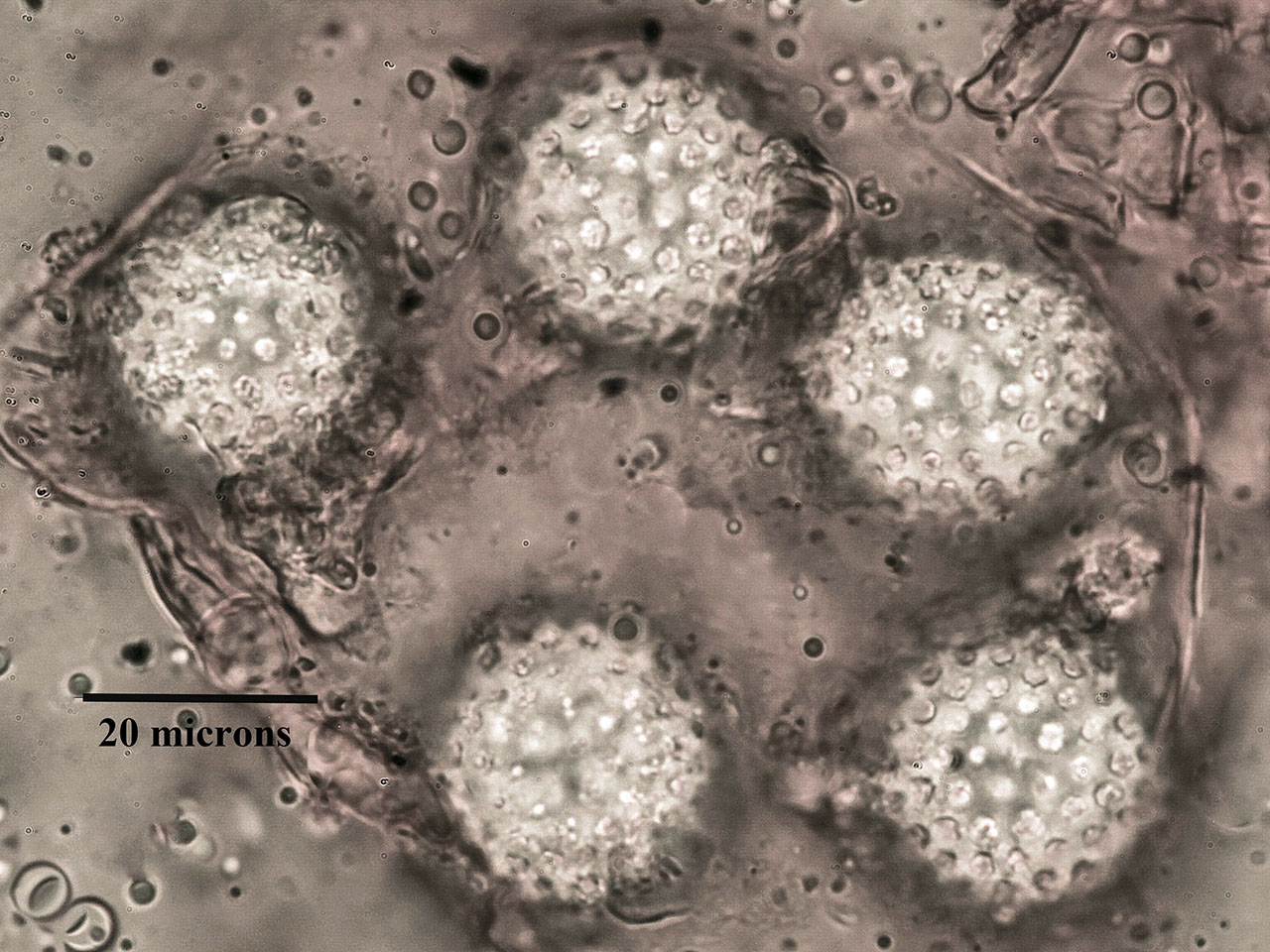 — Spores


