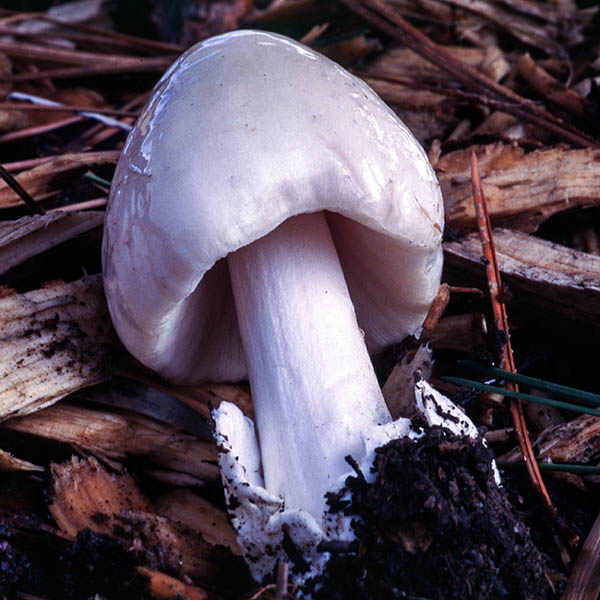
Volvopluteus gloiocephalus
Fungal Biology 115(1): 15. 2011.
Common Name: none
Synonym: Volvariella speciosa (Fr.) Singer; Volvariella gloiocephala (DC.) Boekhout & Enderle
Cap 6-14 cm broad, conic to oval becoming convex, nearly plane at maturity and usually umbonate; white to greyish, sometimes pale greyish-brown, disc darker; surface smooth, viscid when moist, shiny when dry; flesh white, soft; odor of radish.
Gills free, broad, close, white, becoming salmon-colored at maturity.
Stipe 9-18 cm tall, 1.5-2 cm thick, equal, white to pale grey with a white, membranous volva; partial veil absent.
Spores 12-20 x 8-12 µm, smooth, elliptical. Spore print salmon-pink.
Solitary, scattered, to gregarious on disturbed ground, e.g. cultivated fields, near compost heaps, lawns, and chip beds; especially common in areas landscaped with iceplant; fruiting from late winter to spring.
 Edible, of variable quality.
A handsome mushroom,Volvopluteus gloiocephalus is sometimes mistaken for an Amanita because of its stature, free gills and volva. However, at maturity its salmon-colored gills and spores easily distinguish it from Amanita species.
Arora, D. (1986). Mushrooms Demystified. Ten Speed Press: Berkeley, CA. 959 p.
Bas, C., Kyper, T.W., Noordeloos, M.E. & Vellinga, E.C. (1990). Flora Agaricina Neerlandica -- Critical monographs on the families of agarics and boleti occuring in the Netherlands. Volume 2. Pluteaceae, Tricholomataceae. A. A. Balkema: Rotterdam, Netherlands. 137 p.
Bougher, N.L. & Syme, K. (1998). Fungi of Southern Australia. University of Western Australia Press: Nedlands, Australia. 391 p.
Breitenbach, J. & Kränzlin, F. (1995). Fungi of Switzerland. Volume 4: Agarics (2nd Part). Entolomataceae, Pluteaceae, Amanitaceae, Agaricaceae, Coprinaceae, Strophariaceae. Verlag Mykologia: Luzern, Switzerland. 368 p.
Desjardin, D.E., Wood, M.G. & Stevens, F.A. (2015). California Mushrooms: The Comprehensive Identification Guide. Timber Press: Portland, OR. 560 p.
Doveri, F. (2004). Fungi Fimicoli Italici. Associazione Micologica Bresadola: Trento, Italy. 1104 p.
Justo, A., Vizzini, A., Minnis, A.M., Menolli Jr., N., Capelari, M., Rodríguez, O., Malysheva, E., Contu, M., Ghignone, S. & Hibbett, D.S. (2011). Phylogeny of the Pluteaceae (Agaricales, Basidiomycota): taxonomy and character evolution. Fungal Biology 115(1): 1-20.
Orton, P.D. (1986). British Fungus Flora: Agarics and Boleti. Vol 4. Pluteaceae: Pluteus & Volvariella. Royal Botanic Garden: Edinburgh, Scotland. 99 p.
Shaffer, R.L. (1957). Volvariella in North America. Mycologia 49(4): 545-579.
Siegel, N. & Schwarz, C. (2016). Mushrooms of the Redwood Coast. Ten Speed Press: Berkeley, CA. 601 p.