Stropharia coronilla
Mémoires del la Société d'Emulation de Montbéliard sér. II, 5: 237. 1872.
Common Name: none
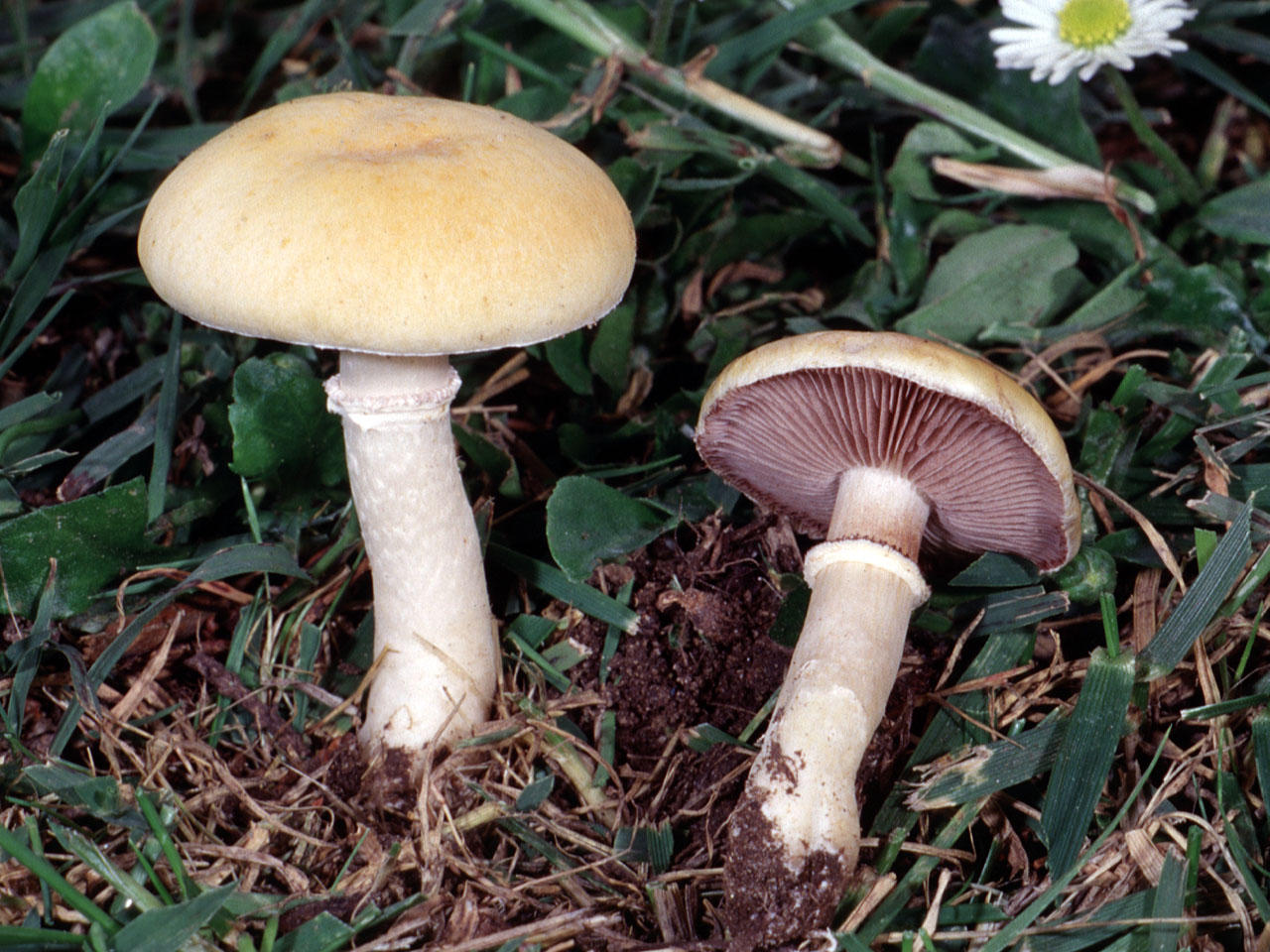
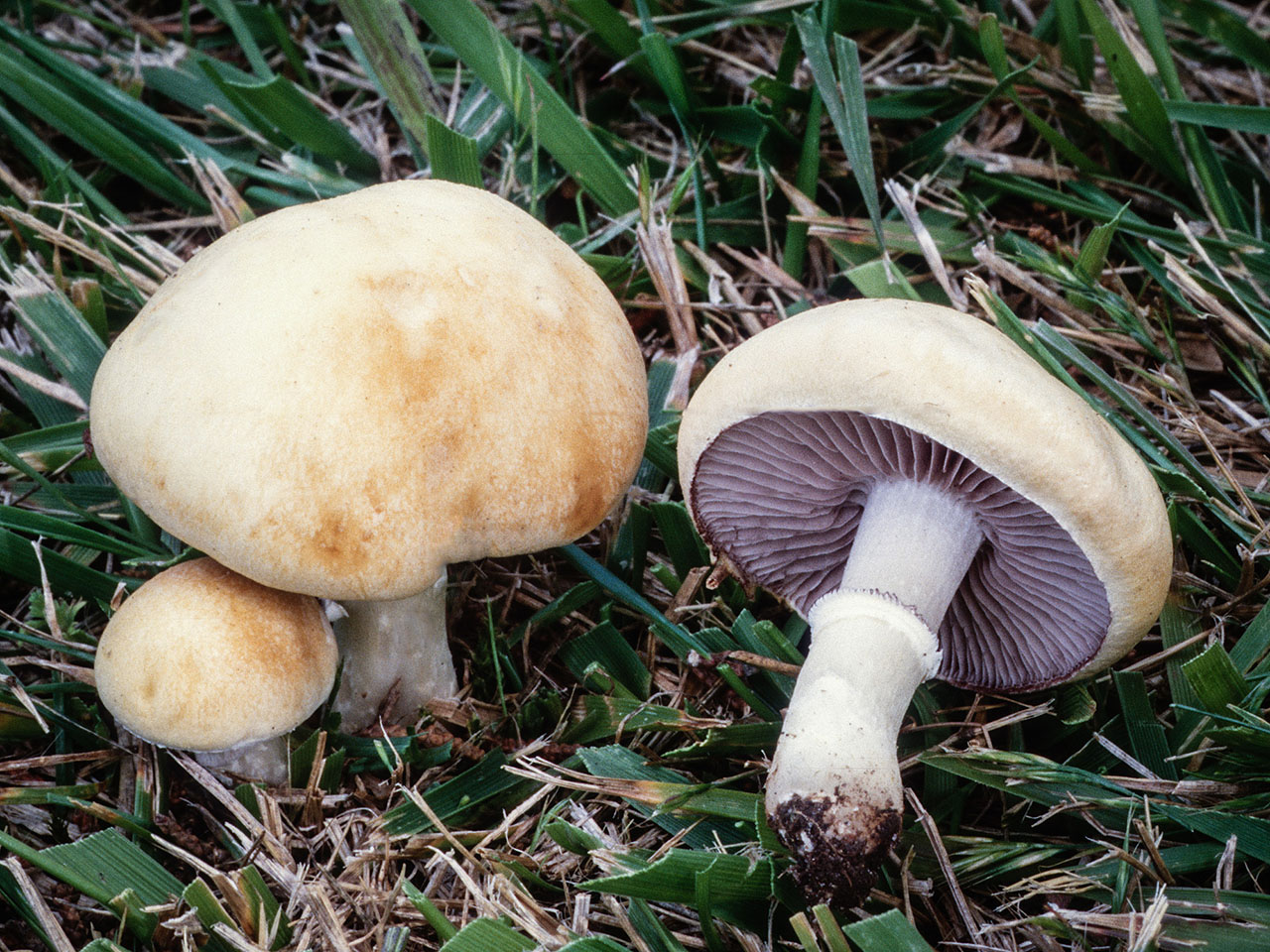
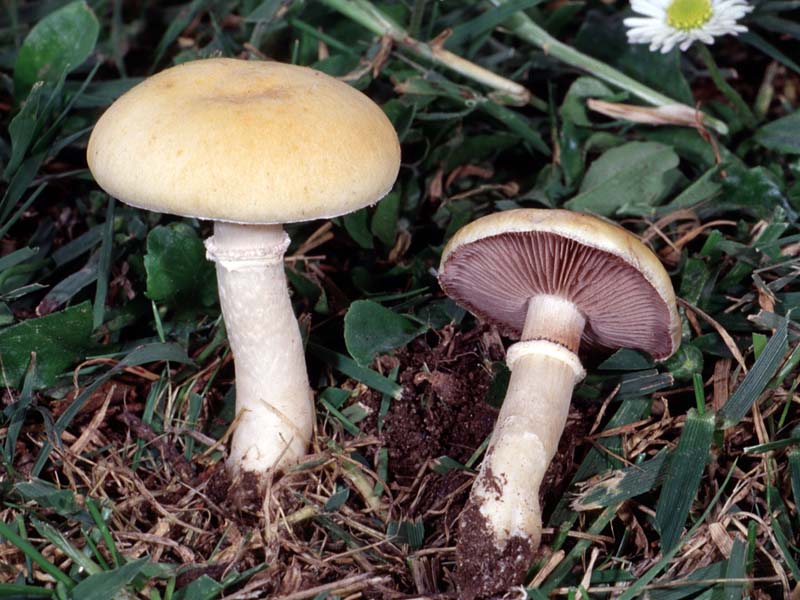
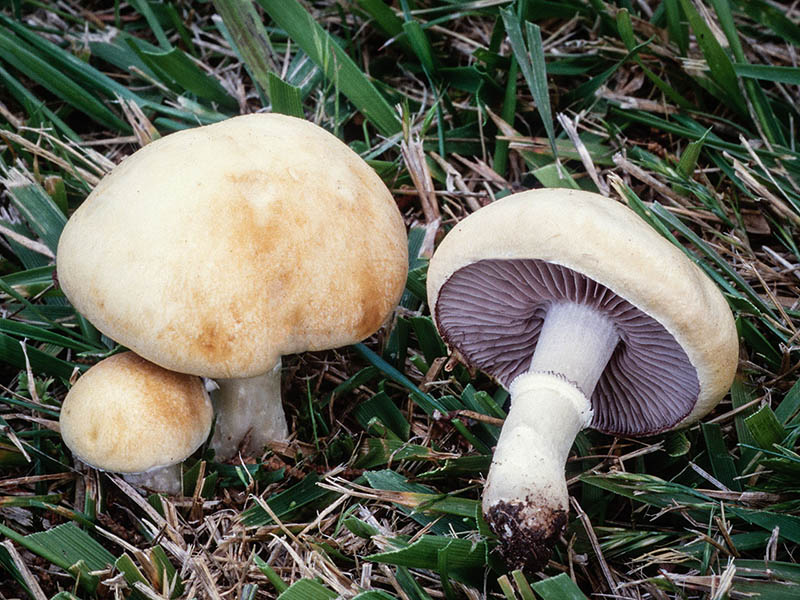
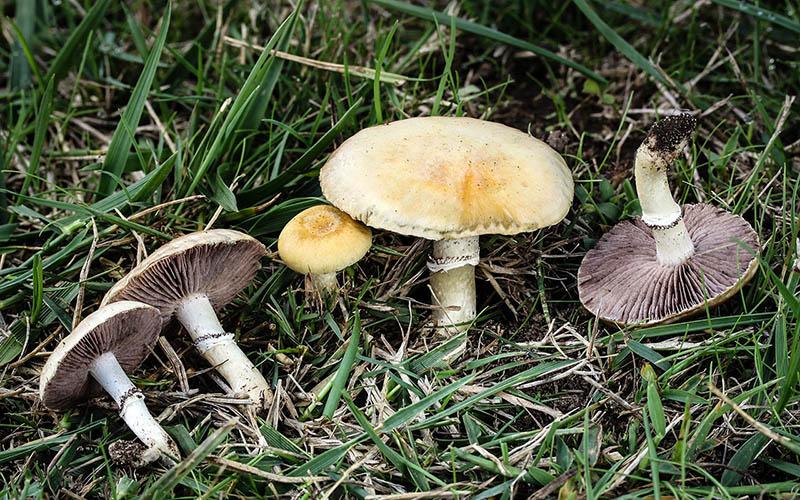
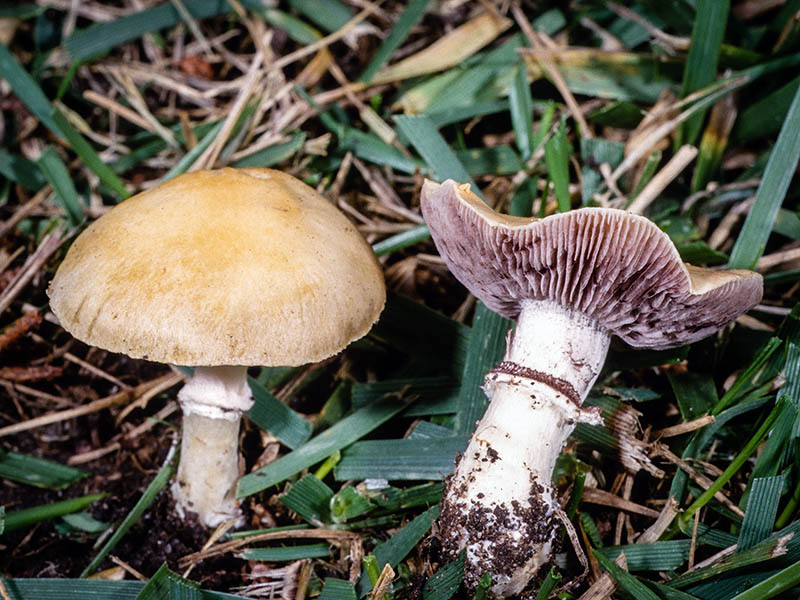
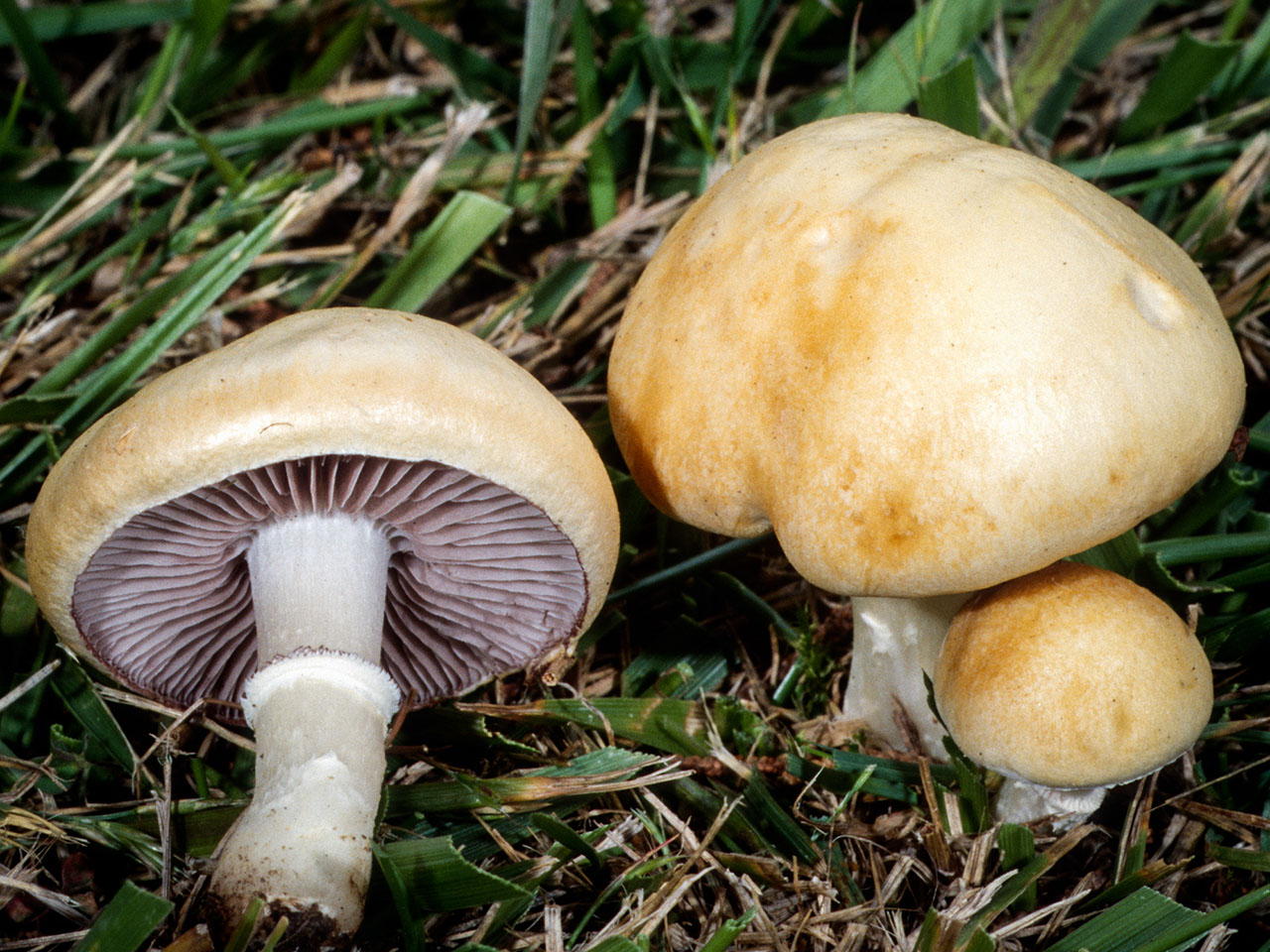
Cap 2-5 cm broad, rounded, becoming convex, finally nearly plane; margin incurved when young, occasionally upturned in age; surface lubricous when moist, smooth, pale yellow-buff, margin lighter; flesh white, firm, thick at the disc, thin at the margin; odor faintly sweet; taste mild.
Gills adnate when young, adnexed to slightly descending in age, close, broad, pale lilac-grey, darkening to greyish-purple at maturity.
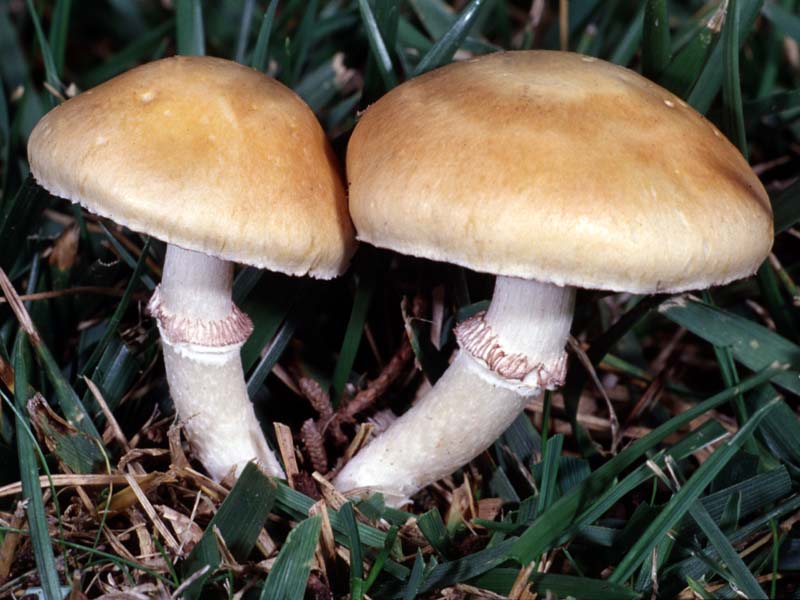
Stipe 1.5-4.5 cm tall, 4-7 mm thick, solid, stuffed at maturity, sometimes hollow at the apex, equal to tapering downward; surface finely tomentose and white above the ring, smooth to finely fibrillose and pale yellowish-buff below; partial veil white, forming a medial to superior, persistent ring, the upper surface conspicuously striate and colored purple-brown by spores; rhizomorphs frequently at the base.
Spore 7-8.5 x 4.5-5.5 µm, elliptical, smooth, with an inconspicuous apical pore; spore print purple brown.
Solitary, scattered, to gregarious in grass; fruiting spring summer and fall in watered areas, less common during the winter months.
Possibly toxic.
Stropharia coronilla is a small, cream to pale yellowish-buff mushroom that is distinguished by a lubricous when moist cap, and annulus with prominent striations on the upper surface, the latter often tinged purple with spores. It superficially resembles an Agaricus species, but lacks the characteristic free gills. Agrocybe pediades, another grass dweller, is similar in size and color, but lacks an annulus and the spores are dull brown, rather than purple brown.
Ammirati, J.F., Traquair, J.A. & Horgen, P.A. (1985). Poisonous Mushrooms of the Northern United States and Canada. University of Minnesota Press: Minneapolis, MN. 396 p.
Arora, D. (1986). Mushrooms Demystified. Ten Speed Press: Berkeley, CA. 959 p.
Bas, C., Kyper, T.W., Noordeloos, M.E. & Vellinga, E.C. (1999). Flora Agaricina Neerlandica—Critical monographs on the families of agarics and boleti occurring in the Netherlands. Volume 4. Strophariaceae, Tricholomataceae. A. A.Balkema: Rotterdam, Netherlands. 191 p.
Breitenbach, J. & Kränzlin, F. (1995). Fungi of Switzerland. Volume 4: Agarics (2nd Part). Entolomataceae, Pluteaceae, Amanitaceae, Agaricaceae, Coprinaceae, Strophariaceae. Verlag Mykologia: Luzern, Switzerland. 368 p.
Desjardin, D.E., Wood, M.G. & Stevens, F.A. (2015). California Mushrooms: The Comprehensive Identification Guide. Timber Press: Portland, OR. 560 p.
Knudsen, H. & Vesterholt, J. ed. (2008). Funga Nordica: Agaricoid, boletoid and cyphelloid genera. Nordsvamp: Copenhagen, Denmark. 965 p. (PDF)
Knudsen, H. & Vesterholt, J. ed. (2012). Funga Nordica: Agaricoid, boletoid, clavarioid, cyphelloid and gastroid genera. Vol. 2. Nordsvamp: Copenhagen, Denmark. 572 p.
Little, B. (1991). A Systematic Study of Hypholoma and for California. Masters Thesis. Humboldt State University: Arcata, CA. 114 p.
Noordeloos, M.E. (2011). Strophariaceae s.l. Edizioni Candusso: Alassio, Italy. 648 p.
Siegel, N. & Schwarz, C. (2016). Mushrooms of the Redwood Coast. Ten Speed Press: Berkeley, CA. 601 p.
Smith, A.H. (1949). Mushrooms in their Natural Habitats. Sawyer's Inc: Portland, OR. 626 p. (PDF)
Watling, R. & Gregory, N.M. (1987). British Fungus Flora: Agarics and Boleti. Vol 5. Strophariaceae & Coprinaceae p.p.: Hypholoma, Melanotus, Psilocybe, Stropharia, Lacymaria, & Panaeolus. Royal Botanic Garden: Edinburgh, Scotland. 121 p.