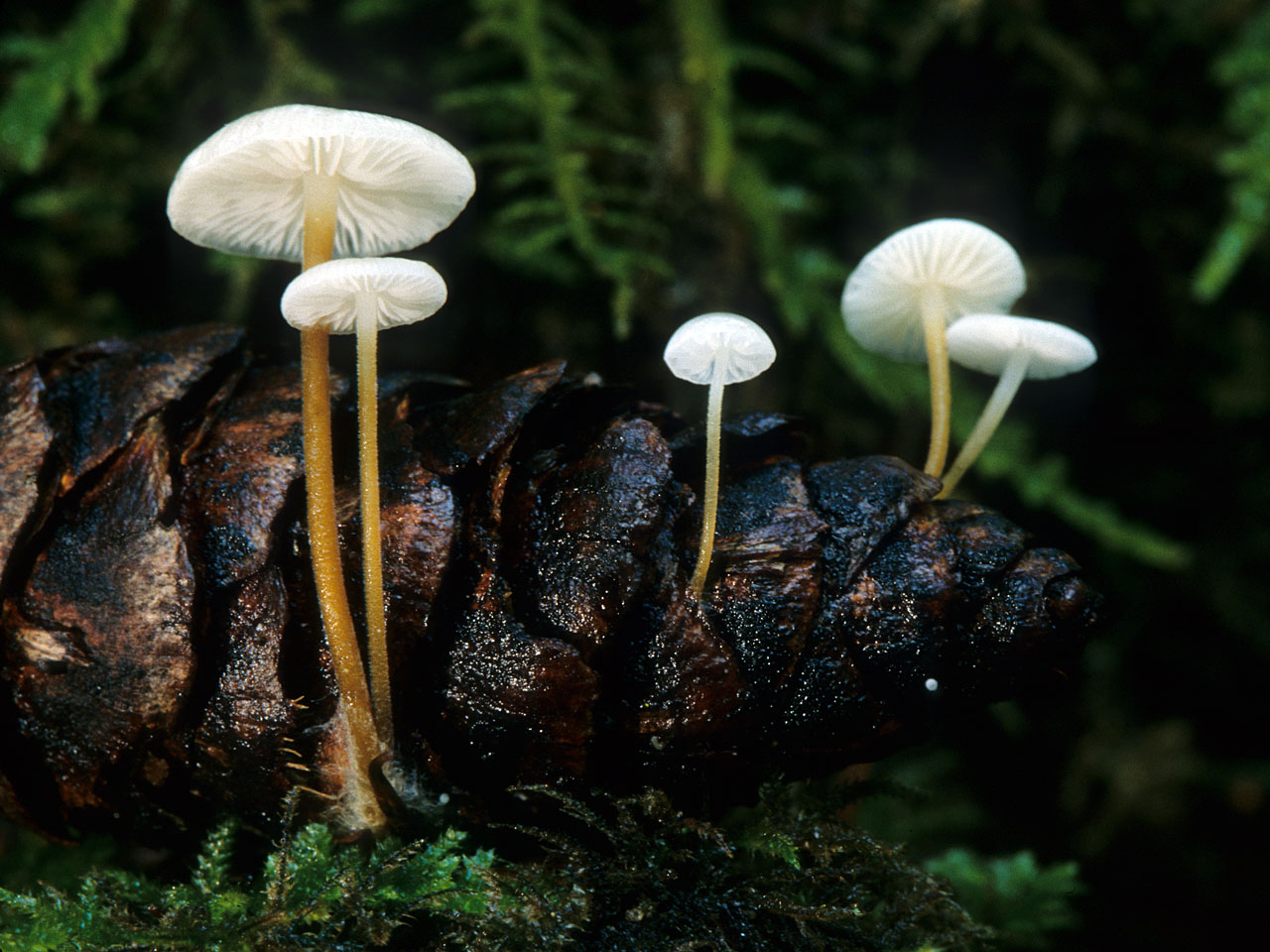
Strobilurus trullisatus
Mycotaxon 9: 179. 1979.
Photo: Showing typical growth on Douglas fir cones.
Common Name: none
Synonyms: Strobilurus kemptonae V.L. Wells; Gymnopus trullisatus Murrill
Cap 0.4-1.7 cm broad, convex, expanding to nearly plane and slightly depressed; surface smooth to faintly wrinkled, pallid brown at the disc shading to a pale pinkish, striate margin; flesh thin and white.
Gills adnate to adnexed, close, white to pinkish-tan.
Stipe 1.5-4.5 cm tall, 0.1-0.2 cm broad, white, subtomentose above, yellowish-brown and pubescent below, orange-brown mycelium at the base; veil absent.
Spores 3.5-6 x 2-3 µm, elliptical, smooth, nonamyloid. Spore print white.
Solitary to grouped on decaying Douglas fir cones; from late summer in areas of fog drip to mid-winter.
Unknown. Too small to be of any culinary value.
Strobilurus trullisatus is one of relatively small number of mushrooms in our area that live on conifer cones. It is recognized by a pale-colored cap with pinkish tones, and a yellowish-brown stipe base. Baeospora myosura also grows on Douglas fir cones, but has a somewhat darker cap, much closer gills, and a distinctly hairy stipe base. A related species, Strobilurus occidentalis, occurs on spruce cones. Strobilurus kemptonae is an older name for this mushroom.
Arora, D. (1986). Mushrooms Demystified. Ten Speed Press: Berkeley, CA. 959 p.
Desjardin, Dennis E. (1985). The Marasmioid Fungi of California. Masters Thesis. San Francisco State University: San Francisco, CA. 287 p.
Desjardin, Dennis E. (1987). The Agaricales (Gilled Fungi) of California. 7. Tricholomataceae I. Marasmioid Fungi. Mad River Press: Eureka, CA. 100 p.
Desjardin, D.E., Wood, M.G. & Stevens, F.A. (2015). California Mushrooms: The Comprehensive Identification Guide. Timber Press: Portland, OR. 560 p.
Lennox, J.W. (1979). Collybioid genera in the Pacific Northwest. Mycotaxon 9(1): 117-231.
Murrill, W.A. (1907). North American Flora: (Agaricales) Polyporaceae-Agaricaceae. 9(5): 297-374. (Protologue)
Siegel, N. & Schwarz, C. (2016). Mushrooms of the Redwood Coast. Ten Speed Press: Berkeley, CA. 601 p.


