Schizophyllum commune
Obs. Myc. 1: 103. 1815.
Common Name: split gill
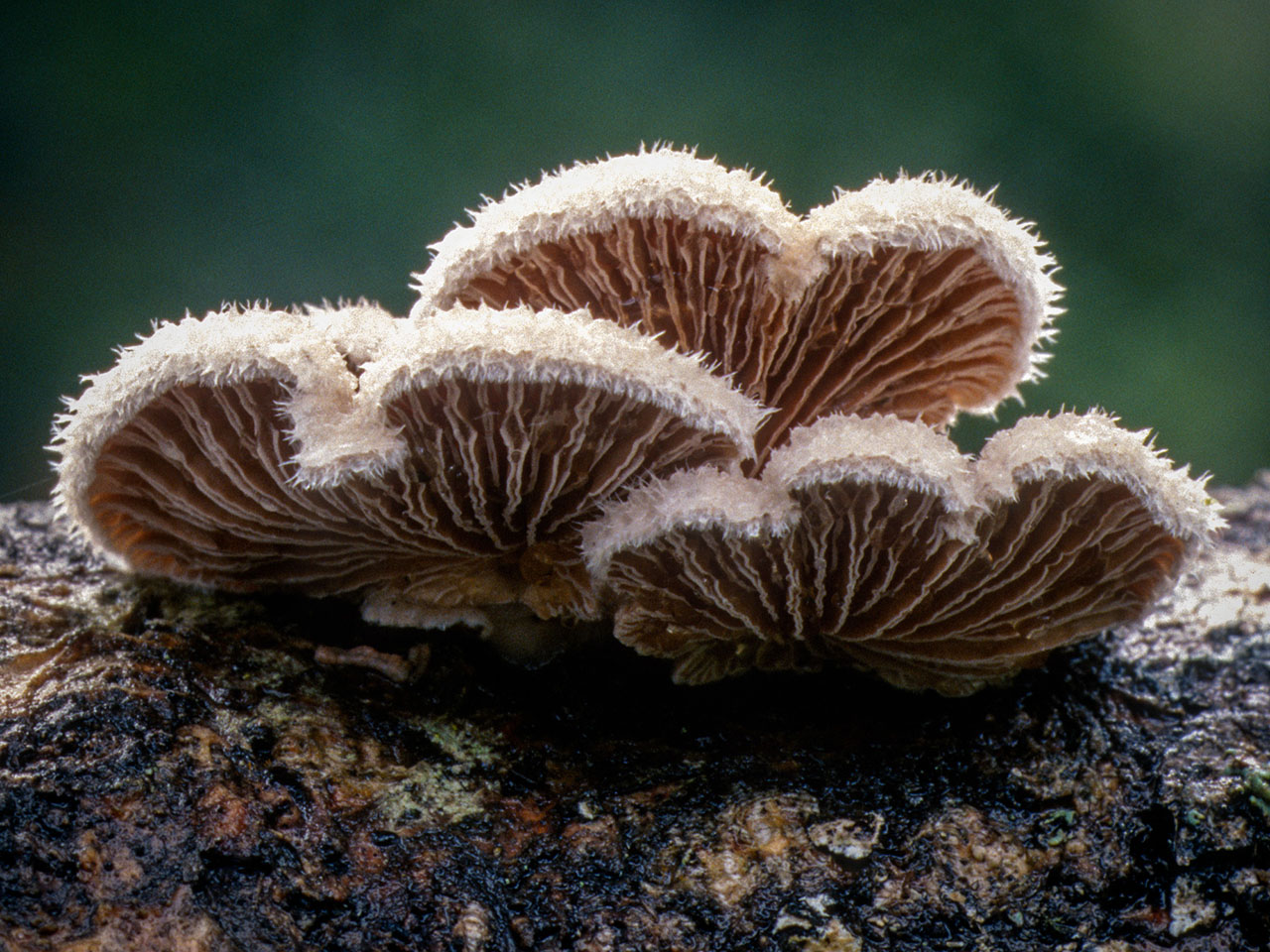
Fruiting body a leathery, fan-shaped bracket, 1-3.5 cm broad, frequently lobed or fused at the base with other brackets; upper surface densely hairy, light greyish-brown when moist, ashy grey to white when dry; lower surface light grey consisting of well spaced, longitudinally split gills; stipe usually absent; flesh thin, light grey to brown, tough.
Spores 3-4 x 1-1.5 µm, cylindrical, smooth; spore print white.
Scattered to clustered on hardwood logs and branches; fruiting after the fall rains, but can be found year round.
 Edible, but small and tough. Schizophyllum commune is cultivated for food in South East Asia.
This small, ashy-grey bracket looks like a polypore but the lower, hymenial surface consists of gills, the latter unusual in that they are split longitudinally. The genus name Schizophyllum, literally means "split leaves" referring to this character. Fruiting bodies are persistent, shriveling in dry weather, but reviving after rains.
Arora, D. (1986). Mushrooms Demystified. Ten Speed Press: Berkeley, CA. 959 p.
Bessette, A.E., Smith, D.G. & Bessette, A.R. (2021). Polypores and Similar Fungi of Eastern and Central North America. University of Texas Press: Austin, TX. 430 p.
Carreño-Ruiz, S.D. & others. (2019). New record of Schizophyllum (Schizophyllaceae) from Mexico and the confirmation of its edibility in the humid tropics. Phytotaxa 413(2): 137-148.
Cooke, W.B. (1961). The Genus Schizophyllum. Mycologia 53(6): 575-599.
Desjardin, D.E., Wood, M.G. & Stevens, F.A. (2015). California Mushrooms: The Comprehensive Identification Guide. Timber Press: Portland, OR. 560 p.
Knudsen, H. & Vesterholt, J. ed. (2008). Funga Nordica: Agaricoid, boletoid and cyphelloid genera. Nordsvamp: Copenhagen, Denmark. 965 p. (PDF)
Knudsen, H. & Vesterholt, J. ed. (2012). Funga Nordica: Agaricoid, boletoid, clavarioid, cyphelloid and gastroid genera. Vol. 1. Nordsvamp: Copenhagen, Denmark. 511 p.
Lindsey, J.P. & Gilbertson, R.L. (1978). Basidiomycetes that Decay Aspen in North America. J. Cramer: Vaduz. 406 p.
Siegel, N. & Schwarz, C. (2016). Mushrooms of the Redwood Coast. Ten Speed Press: Berkeley, CA. 601 p.
Watling, R. & Gregory, N.M. (1989). British Fungus Flora: Agarics and Boleti. Vol 6. Crepidotaceae and other pleurotoid agarics. Royal Botanic Garden: Edinburgh, Scotland. 157 p.

 — older sporocarps


 — not fluorescent
  — fluorescent


