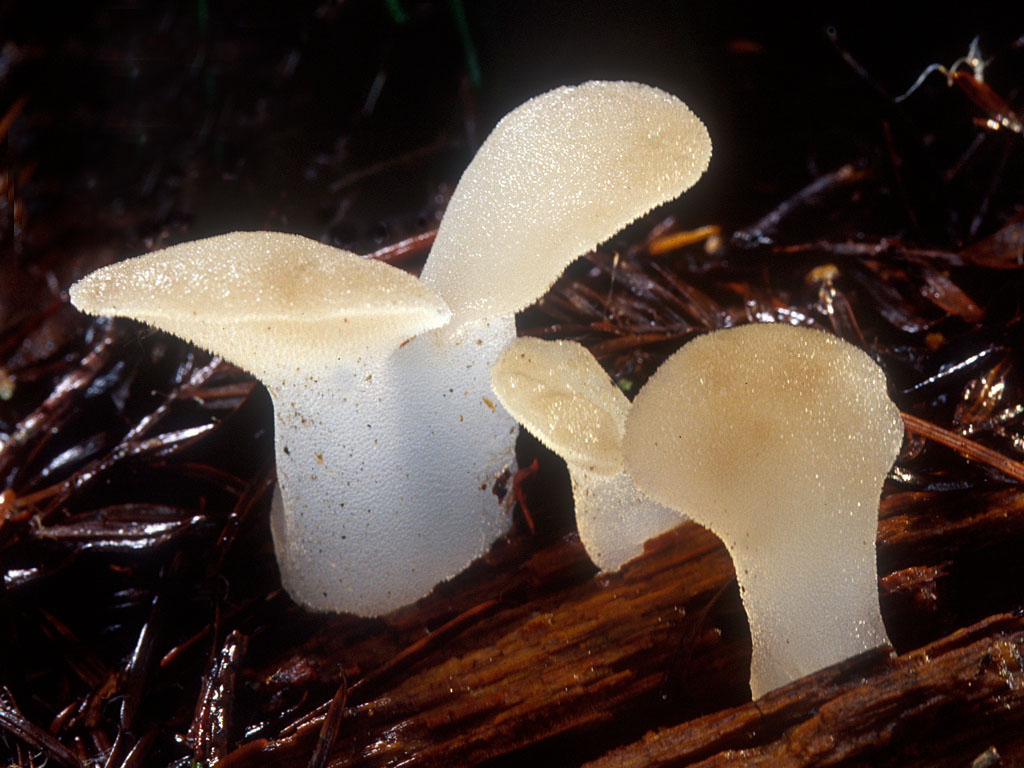
Pseudohydnum gelatinosum
Not. Faun. Fl. Fenn. 9: 374. 1868.
Common Name: Toothed Jelly Fungus
Fruiting body 2-5 cm broad, spatulate to fan-shaped; upper surface translucent, moist, slightly roughened, white to greyish-white when young, pale grey to somewhat brownish in age; hymenial surface on underside, pale grey, consisting of minute conic spines on which the spores are formed; flesh rubbery-gelatinous.
Stipe 5 cm long, up to 1.5 cm broad, lateral, tapering downward, covered with fine hairs, densest at the base; flesh, rubbery-gelatinous.
Spores 5-7 µm, globose, hyaline, smooth. Spores white in deposit.
Solitary, gregarious to clustered on conifer logs and stumps; from late fall to mid-winter.
 Edible, can be eaten raw, but without a distinctive flavor.
Pseudohydnum gelatinosum is a jelly fungus with a lower surface that mimics a tooth fungus. The resemblance, however, is superficial. Tooth fungi have fleshy to leathery fruiting bodies, not gelatinous, and none are translucent.
Arora, D. (1986). Mushrooms Demystified. Ten Speed Press: Berkeley, CA. 959 p.
Breitenbach, J. & Kränzlin, F. (1986). Fungi of Switzerland. Volume 2: Non-Gilled Fungi. Verlag Mykologia: Luzern, Switzerland. 412 p.
Desjardin, D.E., Wood, M.G. & Stevens, F.A. (2015). California Mushrooms: The Comprehensive Identification Guide. Timber Press: Portland, OR. 560 p.
Ellis, M.B. & Ellis, J.P. (1990). Fungi without Gills (Hymenomycetes and Gasteromycetes). Chapman and Hall: London, England. 329 p.
Lowy, B. (1971). Flora Neotropica, Monograph No. 6, Tremellales. Hafner Publishing Company: New York, NY. 154 p.
Martin, G.W. (1964). Revision of the North Central Tremellales. J. Cramer: Lehre. 122 p.
McNabb, R.F.R. (1964). New Zealand Tremellales — I. New Zeal. Journ. Bot. 2: 403-414.
Siegel, N. & Schwarz, C. (2016). Mushrooms of the Redwood Coast. Ten Speed Press: Berkeley, CA. 601 p.
Siegel, N., Mohatt, K. & Trudell, S. (2025). Mushrooms of Alaska. Timber Press: New York, NY. 572 p.
Smith, A.H. (1949). Mushrooms in their Natural Habitats. Sawyer's Inc: Portland, OR. 626 p. (PDF)