Pleurotus ostreatus
Champ. Jura. Vosg. 1: 112. 1872.
Common Name: oyster mushroom
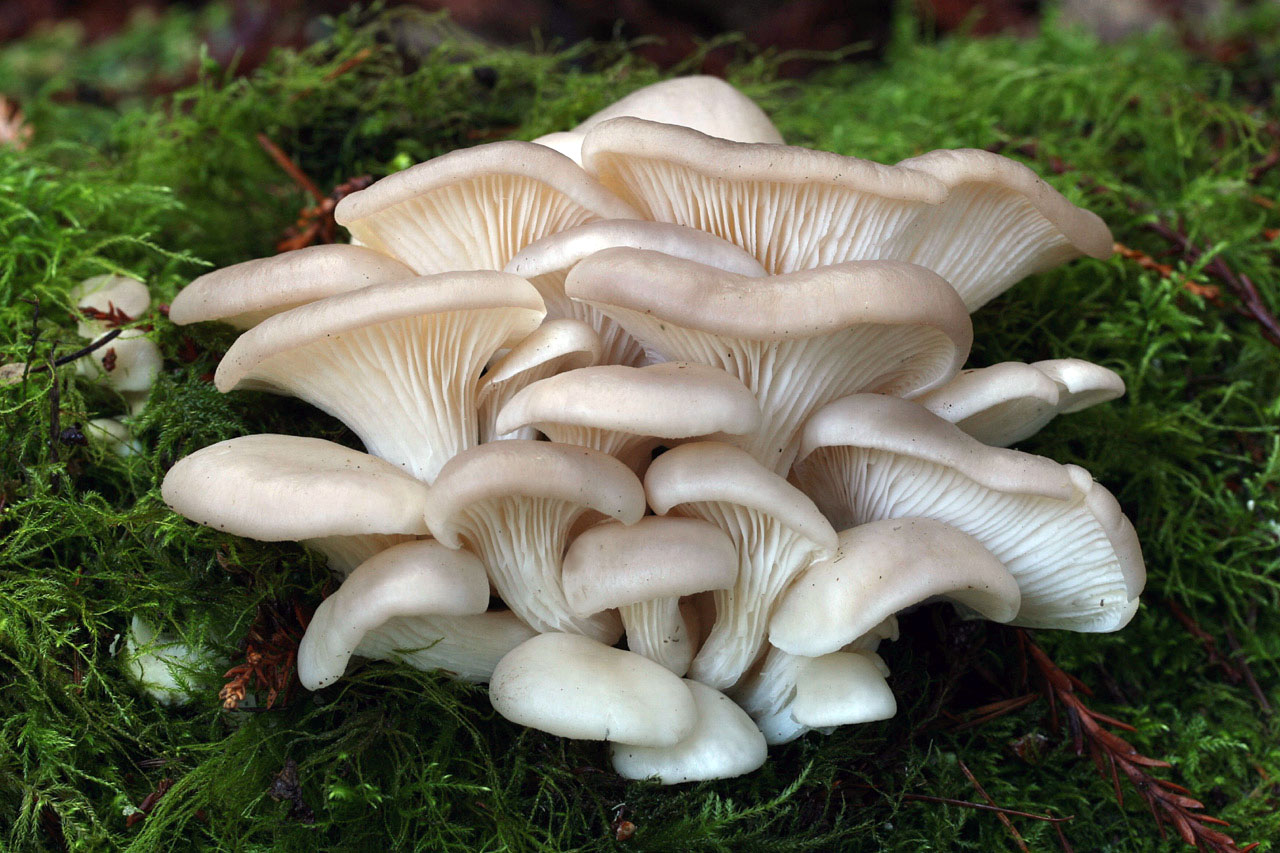
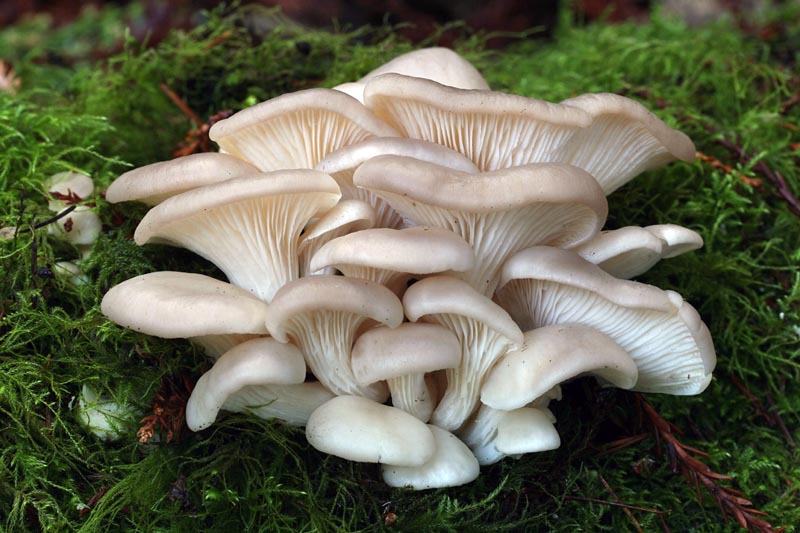
Cap 5-25 cm broad, fan-shaped, broadly convex to sometimes nearly plane at maturity; margin lobed to wavy, especially when young; surface smooth, white to greyish-brown; flesh white, odor of anise.
Gills decurrent, white, yellowish in age; veil absent.
Stipe often absent, when present, short and thick: 0.5-3.0 cm long, 0.5-2.0 cm thick, eccentric or lateral with dense white hairs at the base.
Spores 7.5-9 x 3.5-4.5 µm, smooth, elliptical, nonamyloid. Spore print white.
Forming overlapping shelves or clusters on stumps and logs of hardwoods, uncommon on conifers, from early fall to mid- winter. Pleurotus ostreatus is a member of the "Fog Flora" fruiting sporadically along the coast during the summer.
 Edible and very popular, although a few people are allergic to it.
Pleurotus ostreatus is believed to be a species complex. In the California, specimens can be found that vary from white and relatively thin-fleshed on oaks to thick fleshed, grey-brown shelves on cottonwood and willow. Whether these differences are environmentally induced or genetic is not clear, but most mycophagists prefer the large, thick-fleshed specimens collected from cottonwood.
Arora, D. (1986). Mushrooms Demystified. Ten Speed Press: Berkeley, CA. 959 p.
Bas, C., Kyper, T.W., Noordeloos, M.E. & Vellinga, E.C. (1990). Flora Agaricina Neerlandica—Critical monographs on the families of agarics and boleti occuring in the Netherlands. Volume 2. Pluteaceae, Tricholomataceae. A. A. Balkema: Rotterdam, Netherlands. 137 p.
Breitenbach, J. & Kränzlin, F. (1991). Fungi of Switzerland. Volume 3: Boletes and Agarics (1st Part). Strobilomycetaceae, Boletaceae, Paxillaceae, Gomphidiaceae, Hygrophoraceae, Tricholomataceae, Polyporaceae (lamellate). Verlag Mykologia: Luzern, Switzerland. 361 p.
Desjardin, D.E., Wood, M.G. & Stevens, F.A. (2015). California Mushrooms: The Comprehensive Identification Guide. Timber Press: Portland, OR. 560 p.
Knudsen, H. & Vesterholt, J. ed. (2008). Funga Nordica: Agaricoid, boletoid and cyphelloid genera. Nordsvamp: Copenhagen, Denmark. 965 p. (PDF)
Knudsen, H. & Vesterholt, J. ed. (2012). Funga Nordica: Agaricoid, boletoid, clavarioid, cyphelloid and gastroid genera. Vol. 1. Nordsvamp: Copenhagen, Denmark. 511 p.
Petersen, R.H. & Krisai-Greilhuber, I. (1996). An epitype specimen for Pleurotus ostreatus. Mycol. Res. 100(2): 229-235.
Siegel, N. & Schwarz, C. (2016). Mushrooms of the Redwood Coast. Ten Speed Press: Berkeley, CA. 601 p.
Smith, A.H. (1949). Mushrooms in their Natural Habitats. Sawyer's Inc: Portland, OR. 626 p. (PDF)
Watling, R. & Gregory, N.M. (1989). British Fungus Flora: Agarics and Boleti. Vol 6. Crepidotaceae and other pleurotoid agarics. Royal Botanic Garden: Edinburgh, Scotland. 157 p.