Mycenastrum corium
Annales des Sciences Naturelles, Sér. II, 17: 147. 1842.
Common Name: none
Fruiting body sub-hypogeous to emergent, 7–17 cm broad, 5–8 cm tall, compressed globose to turbinate, abruptly tapered to a pointed base, attached by a well developed tuft of mycelium to the substrate; exoperidium, white to buff, relatively thick, in age forming a thin, patchy covering; endoperidium thick (up to 2 mm) tough, leathery, blackish-brown; spores released by splitting of the endoperidium into irregularly shaped sections; gleba whitish, maturing olive-brown to dark-brown, drying medium-brown; coarse mycelial strands seen near the base of the gleba; subgleba absent; odor somewhat pungent, earthy; taste slightly astringent.
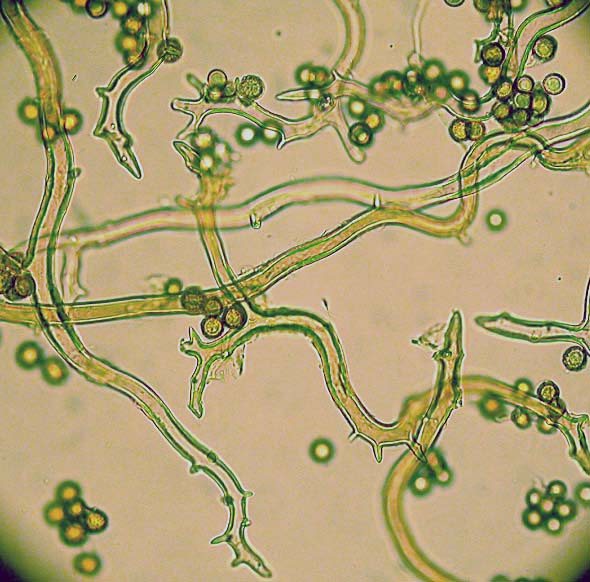
Spores 8–11.5 µm,globose, thick-walled, warted, partially to completely reticulate, with a central droplet; pedicel inconspicuous,< 1 micron long; capillitium of individual elements, thick-walled, not pitted, occasionally branched, with distinctive thorn-like projections; spores medium-brown.
Solitary, scattered, or in rings, occasionally clustered; fruiting in pastures or around compost heaps after fall rains; occasional.
Unknown.
The hallmark of this thick-skinned puffball is a peridium that splits into sections sometimes giving dried sporocarps a star-like shape. In this respect, Mycenastrum corium is very similar to Calvatia pachyderma. Though not closely related, the latter also has a thick-walled, splitting peridium that sometimes recurves in age, but lacks the thick mycelial strands seen at the base of the gleba of Mycenastrum corium. Additionally, it differs microscopically with a different type of capillitium and nearly smooth, often ovoid spores. Other puffballs with peridia that split into sections include Bovista pila and Scleroderma polyrhizum. Bovista pila is distinguished by a relatively thin, parchment-like peridium, that often has a metallic sheen, and elastic gleba, while Scleroderma polyrhizum, though possessing a thick-walled peridium, has a purplish-brown gleba, and also lacks strands of thickened mycelium at the base of the gleba.
Arora, D. (1986). Mushrooms Demystified. Ten Speed Press: Berkeley, CA. 959 p.
Bates, S.T. (2004). Arizona members of the Geastraceae and Lycoperdaceae (Basidiomycota, Fungi). Masters Thesis. Arizona State University: Tempe, AZ. 445 p.
Calonge, F.D. (1998). Flora Mycologica Iberica. Vol. 3. Gasteromycetes, I. Lycoperdales, Nidulariales, Phallales, Sclerodermatales, Tulostomatales. J. Cramer: Berlin, Germany. 271 p.
Coker, W.C. & Couch, J.N. (1974). The Gasteromycetes of the Eastern United States and Canada. Dover Publications, Inc: New York, NY. 201 p. (PDF)
Desjardin, D.E., Wood, M.G. & Stevens, F.A. (2015). California Mushrooms: The Comprehensive Identification Guide. Timber Press: Portland, OR. 560 p.
Jarvis, S.S. (2014). The Lycoperdaceae of California. Masters thesis. San Francisco State University: San Francisco, CA. 336 p.
Jeppson, M. (2018). Puffballs of Northern and Central Europe. Sveriges Mykologiska Förening: Gothenburg, Sweden. 359 p.
Long, W.H. (1930). The Dehiscence of Mycenastrum corium. Mycologia 22(3): 103-105.
Miller Jr., O.K., Brace, R.-L. & Evenson, V. (2005). A new subspecies of Mycenastrum corium from Colorado. Mycologia 97(2): 530-533.
Smith, A.H. (1951). Puffballs and Their Allies in Michigan. University of Michigan Press: Ann Arbor, MI. 131 p.