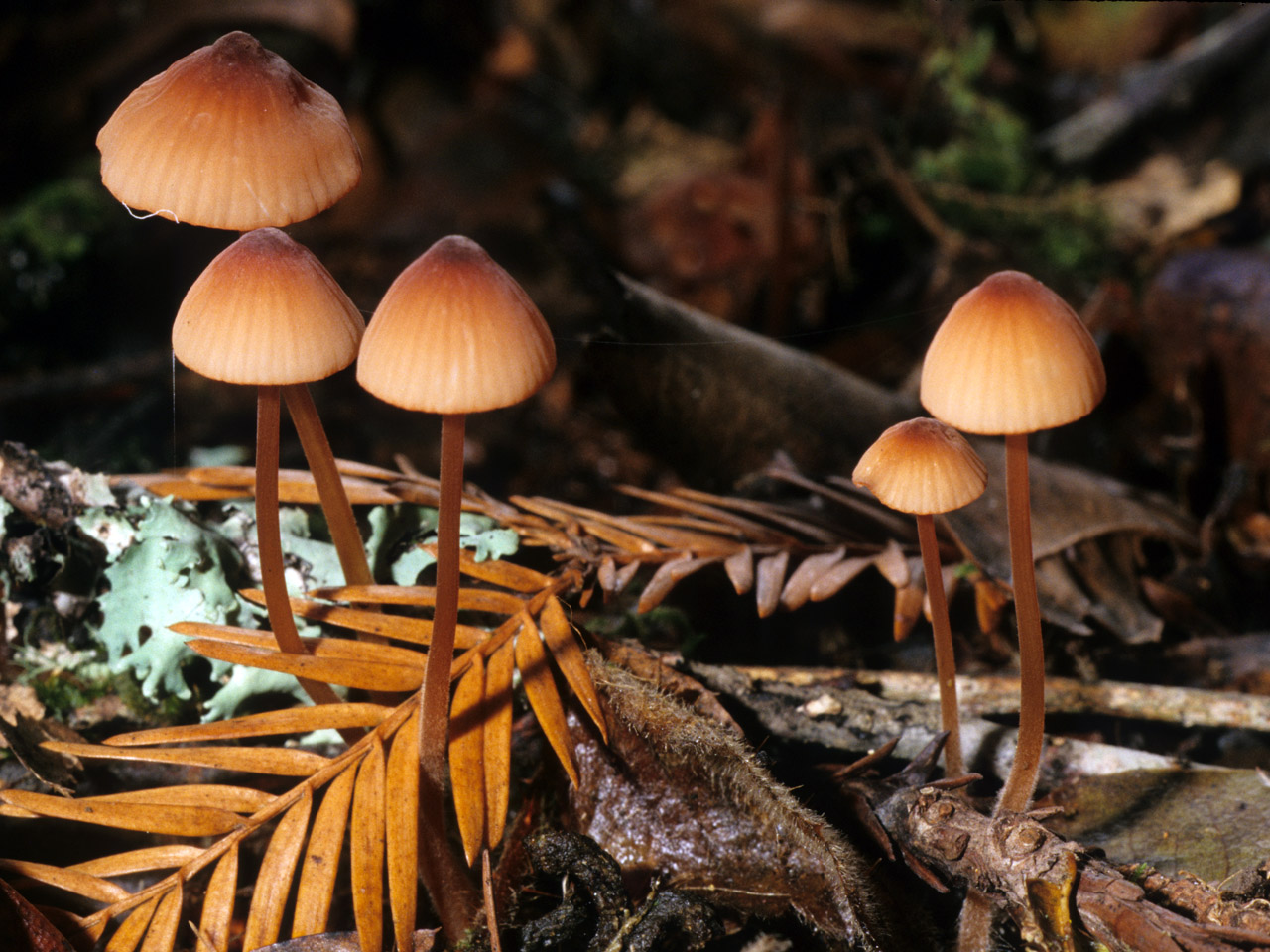
Mycena californiensis
Syll. Fung. 5: 255. 1887.
Common Name: none
Synonyms: Mycena elegantula Peck; Agaricus californiensis Berkeley & Curtis
Misapplied name: Mycena sanguinolenta
Cap 0.7-2.0 cm broad, conic, campanulate in age, the margin striate to slightly ridged; surface smooth, orange-brown at the disc, paler at the margin; flesh thin, reddish-brown, exuding a reddish juice when injured; odor and taste mild.
Gills adnate, subdistant, moderately broad, white, sometimes with reddish blush, the edges reddish-brown.
Stipe 2-7 cm long, 1-2 mm thick, slender, fragile, hollow; equal, with white hairs at the base; surface smooth, concolorous with the cap; flesh exuding a reddish juice when cut; veil absent.
Spores 7.5-9 x 4-4.5 µm, elliptical, smooth, slightly amyloid; spore print white.
Gregarious to in troops on hardwood duff, especially oaks (Quercus); fruiting from late fall to early winter.
Unknown.
Mycenas are among the earliest mushrooms to fruit and one of the most common under oak is Mycena californiensis. It is recognized by a reddish-brown cap, marginate gills, a hairy-stipe base that bleeds reddish juice, and oak duff habit. Several other Mycenas resemble this species including Mycena purpureofusca, a marginate-gilled form of Mycena haematopus, and M. sanguinolenta. Mycena purpureofusca is distinguished by a purple-brown, not orange-brown cap, a stipe that does not bleed reddish juice, and a preference for fruiting on pine cones (sometimes buried). Mycena haematopus also has a differently colored cap, vinaceous to pinkish-brown, rather than reddish-brown, has a distinctive scalloped, hairy-capped margin, and is found on rotting wood. Mycena sanguinolenta is very similar to M. californiensis and until recently was the name used for this taxon. However, according to Brian Perry, who is monographing California Mycenas, Mycena sanguinolenta is a distinct species differing from M. californiensis microscopically and in substrate preference. Its fruiting substrate is believed to be rotting wood and debris of Douglas fir and coast redwood. Perry has also determined that Mycena elegantula, a name that has been applied in California to vinaceous-capped marginate-gilled Mycenas, is a synonym of Mycena californiensis.
Berkeley, M. J. & Curtis, M. A. (1860). Characters of new
fungi collected in the North Pacific Exploring Expedition
by Charles Wright. Proc. Amer. Acad. Arts 4: 111-130. (Protologue)
Breitenbach, J. & Kränzlin, F. (1991). Fungi of Switzerland. Volume 3: Boletes and Agarics (1st Part). Strobilomycetaceae, Boletaceae, Paxillaceae, Gomphidiaceae, Hygrophoraceae, Tricholomataceae, Polyporaceae (lamellate). Verlag Mykologia: Luzern, Switzerland. 361 p.
Desjardin, D.E., Wood, M.G. & Stevens, F.A. (2015). California Mushrooms: The Comprehensive Identification Guide. Timber Press: Portland, OR. 560 p.
Perry, Brian A. & Desjardin, Dennis E. (1999). Mycena californiensis Resurrected. Mycotaxon 70: 87-89. (PDF)
Perry, Brian A. (2002). A Taxonomic Investigation of Mycena in California. Masters Thesis, San Francisco State University: San Francisco, CA. 157 p. (PDF)
Siegel, N. & Schwarz, C. (2016). Mushrooms of the Redwood Coast. Ten Speed Press: Berkeley, CA. 601 p.
Smith, Alexander H. (1947). North American Species of Mycena. University of Michigan Press: Ann Arbor, MI. 521 p.
(PDF)