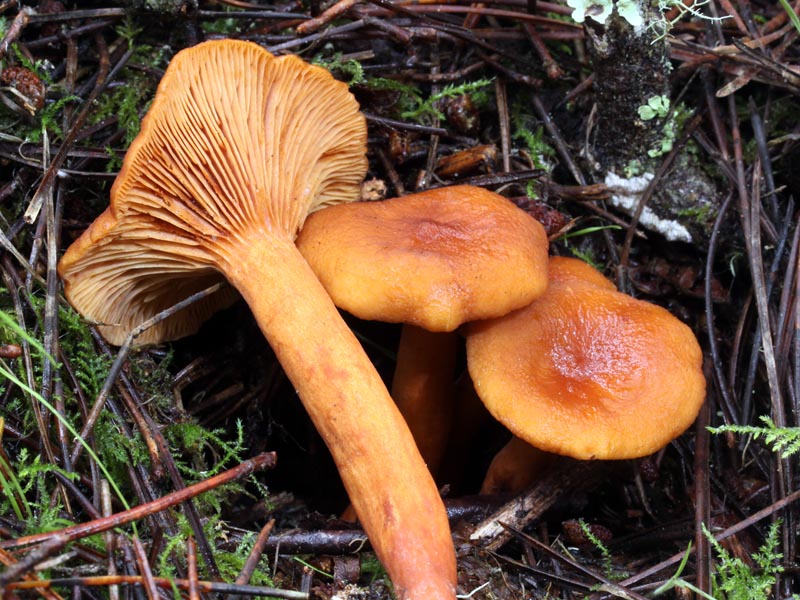
Lactarius rubidus
Mycotaxon 124(1): 324. 2013.
Common Name: candy cap
Synonym: Lactarius fragilis var. rubidus Hesler & A.H. Sm.
Misapplied name: Lactarius camphoratus
Cap 1.5-4.5 cm broad, convex with a slightly inrolled margin when young, becoming nearly plane, occasionally with a small umbo but more typically with a depressed disc, the margin wavy and sometimes upturned in age; surface smooth to faintly furrowed, rusty-brown, azonate; flesh thin, brittle, pale buff-brown, unchanging, bleeding a watery latex when cut; taste mild; odor faintly of brown sugar or butterscotch.
Gills subdecurrent, moderately broad, close, pale pinkish-brown, darker in age, exuding a watery latex when injured.
Stipe 2-5 cm tall, 0.4-1.0 cm thick, equal to tapered to slightly narrowed base, sometimes twisted, brittle, hollow at maturity; surface, smooth, lined at the apex from gill edges, colored as the cap.
Spores 6.5-7.5 µm, nearly round, with amyloid reticulate ornamentation; spore print cream-buff.
Solitary to scattered in mixed hardwood/conifer woods; in humus, moss, rotting wood, along trails, and road banks; fruiting from mid to late winter.
 Edible and good; often used in breads and confections, but one of us (MGW) believes it is better used in savory dishes. See Comments below for caution regarding look-alikes.
This species has been known as Lactarius fragalis var. rubidus. Dr. Andy Methven has proposed the promotion of the variety to species rank and the mushroom is now known as Lactarius rubidus.
Lactarius rubidus is characterized by a rusty-brown, usually depressed cap, subdecurrent, pinkish buff gills that bleed a watery latex, and a smooth, brittle stipe colored like the cap. Fresh specimens have a faint, sweet odor, but when dried smell strongly of fenugreek and maple syrup, thus the common name "candy cap". Hesler and Smith, in their monograph of the genus noted that 64 year old herbarium material of Lactarius fragilis var. fragilis still retained the odor! Several other "candy cap" look-alikes, not all edible, occur in our area, thus caution is advised when collecting for the table. Lactarius rufulus is an edible, larger version of the "candy cap". It has a watery latex, but does not have as strong odor when dried. Microscopically it also differs in lacking clumps of thin-walled round cells in its cap and stipe tissue. Lactarius rufus, L. xanthogalactus, L. luculentus and L. subviscidus are reddish colored species all of which have a white latex, at least when initially exposed, and vary in acridness.
Desjardin, D.E., Wood, M.G. & Stevens, F.A. (2015). California Mushrooms: The Comprehensive Identification Guide. Timber Press: Portland, OR. 560 p.
Kuo, M., Methven, A.S., Minnis, A.M. & Halling, R.E. (2013). Studies of North American macrofungi, 1. Validation of Lactarius rubidus comb. nov. and Leccinellum quercophilum sp. nov. Mycotaxon 124(1): 323-332. (Protologue)
Methven, A.S. (1997). The Agaricales (Gilled Fungi) of California. 10. Russulaceae II. Lactarius. Mad River Press: Eureka, CA. 79 p.
Methven, A.S. (1998). Lactarius in California and Beyond: Introduction to Subgenera and Species of Lactarius in California. Privately Published: Charleston, IL. 22 p. (PDF)
Hesler, L.R. & Smith, A.H. (1979). North American Species of Lactarius. University of Michigan Press: Ann Arbor, MI. 841 p. (PDF)
Siegel, N. & Schwarz, C. (2016). Mushrooms of the Redwood Coast. Ten Speed Press: Berkeley, CA. 601 p.