
Lactarius alnicola
Brittonia 12: 319. 1960.
Common Name: none
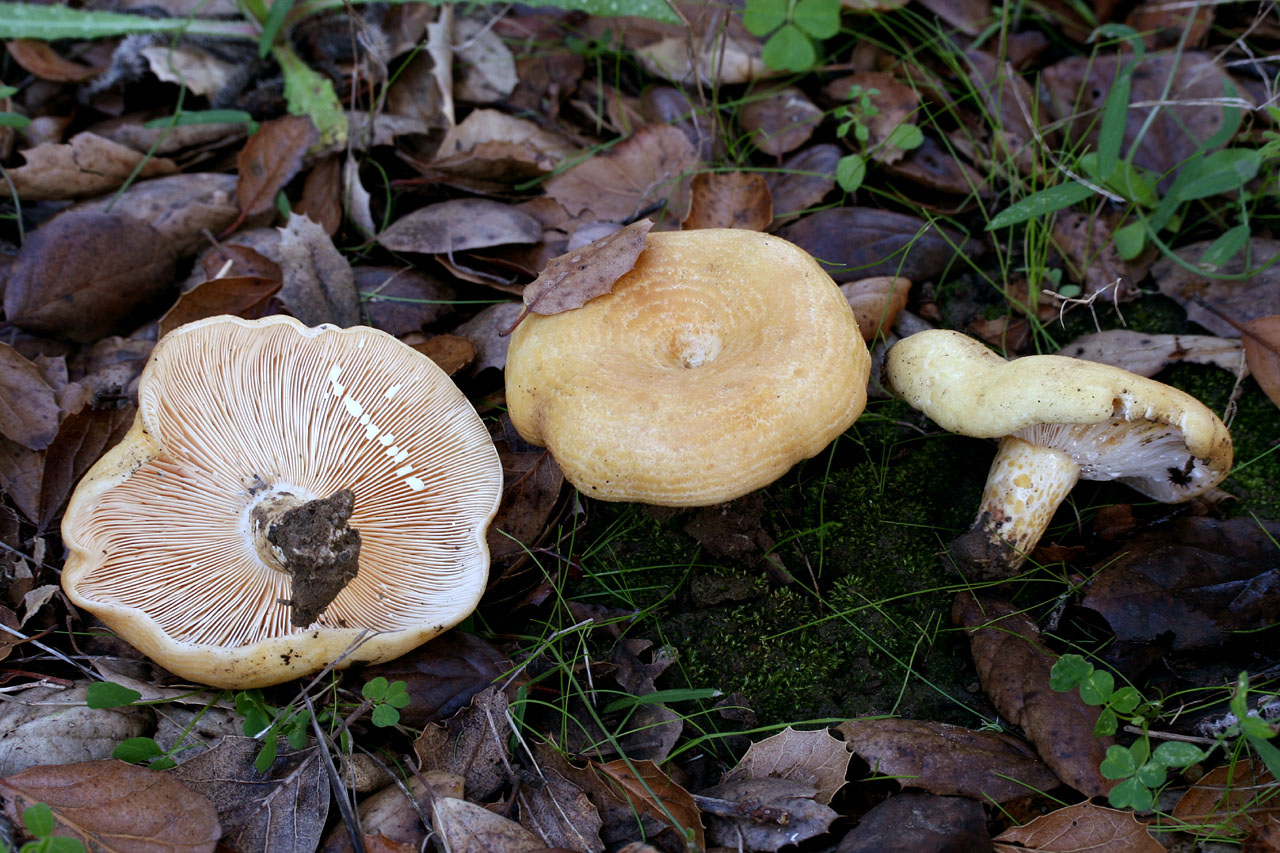
Cap 6-13 cm broad, convex, becoming shallowly infundibuliform; margin inrolled when young, sometimes slightly pubescent, but smooth in age; surface viscid, a mixture of yellow tones arranged in faint concentric bands; flesh, thick, white, firm; odor indistinct, taste very peppery.
Gills decurrent, crowded, narrow, white becoming yellow-buff, bruising yellowish; latex white, usually unchanging, but sometimes pale yellow.
Stipe 2-5 cm tall, 1.5-2.5 cm thick, equal to tapered at the base, at first solid, then hollow, whitish at the apex, ochraceous-brown elsewhere, with darker yellow-brown spots (scrobiculations); veil absent.
Spore 7-10 x 6-8 µm, elliptical with reticulate, amyloid ornamentation; spore print white to pale yellow.
Solitary to gregarious in mixed hardwood/conifer woods; common locally under Quercus (oaks) and Salix (willows); fruiting from early fall to mid-winter.
Inedible; intensely peppery.
Lactarius alnicola is distinguished by a viscid, vanilla-colored, slightly zonate cap, white, usually unchanging latex and a yellow-brown spotted stipe. It is rather common in our area under Quercus agrifolia (coast live oak) where inexperienced collectors sometimes mistake if for the yellow chanterelle, Cantharellus cibarius. It is a mistake made only once as the taste is unforgettably peppery. Ironically, despite its species name, Lactarius alnicola is not common under alder.
Desjardin, D.E., Wood, M.G. & Stevens, F.A. (2015). California Mushrooms: The Comprehensive Identification Guide. Timber Press: Portland, OR. 560 p.
Methven, A.S. (1997). The Agaricales (Gilled Fungi) of California. 10. Russulaceae II. Lactarius. Mad River Press: Eureka, CA. 79 p.
Methven, A.S. (1998). Lactarius in California and Beyond: Introduction to Subgenera and Species of Lactarius in California. Privately Published: Charleston, IL. 22 p. (PDF)
Hesler, L.R. & Smith, A.H. (1979). North American Species of Lactarius. University of Michigan Press: Ann Arbor, MI. 841 p. (PDF)


 — closeup


