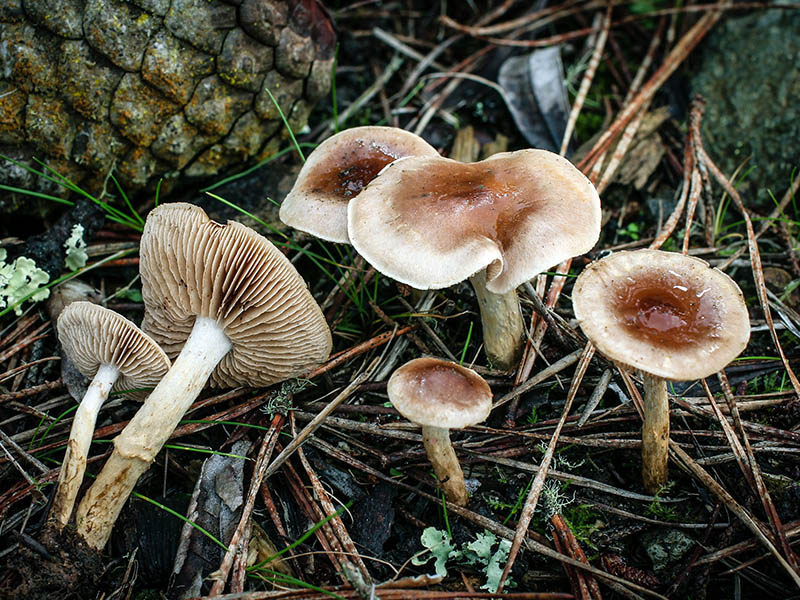
Hebeloma mesophaeum
Champ. Jura et Vognes p. 128. 1872.
Common Name: none
Cap 20-50 mm broad, broadly convex, in age plane to centrally depressed, with or without a low umbo; margin decurved, eventually level, sometimes wavy; surface viscid when moist, brown to dull reddish brown at disc, pallid at the margin; context thin, 2-3 mm thick, cream to buff; odor raphanoid; taste mild.
Gills adnexed to notched, close, relatively broad, up to 8 mm in width, cream colored when young, maturing dull brown, edges finely crenate to minutely fringed (use hand lens); lamellulae in 3-4 series.
Gills adnexed to notched, close, relatively broad, up to 8 mm in width, cream colored when young, maturing dull brown, edges finely crenate to minutely fringed (use hand lens); lamellulae in 3-4 series.
Spores 7.5-9.5 (10) x 5-5.5 µm, ellipsoid, slightly inequilateral in profile, finely punctate at 1000X, lacking a germ pore, hilar appendage conspicuous, inamyloid; spores dull brown in deposit.
Scattered or in small groups under conifers, especially pines, sometimes in mixed woods; fruiting from late fall to mid-winter; occasional to common in wet years.
 Toxic.
This drab brown mushroom is recognized by a bicolored cap, brown to reddish-brown at the disc, shading to cream or buff at the margin. Scattered veil fibrils are typically seen on the stipe sometimes forming an ephemeral ring. Additional although not definitive field characters include a radish-like odor and conifer habit. The radish odor, common to many Hebeloma species, helps to distinguish it from Inocybes which have similar colored spores, but different odors. Inocybe species also typically have conspicuously fibrillose, dry caps. Some Cortinarius species are also similar, but they have rusty, not dull brown spores and usually a well-developed fibrillose partial veil. It should be noted that there is considerable uncertainty regarding the species concept of Hebeloma mesophaeum. Smith et.al in The Veiled Species of Hebeloma regard it as a “collective species” listing 11 varieties differing subtly. The above description covers what is commonly seen under pines in the San Francisco Bay Area.
Arora, D. (1986). Mushrooms Demystified. Ten Speed Press: Berkeley, CA. 959 p.
Beker, H.J., Eberhardt, U. & Vesterholt, J. (2016). Hebeloma (Fr.) P. Kumm. Edizioni Tecnografica: Lomazzo, Italy. 1217 p.
Breitenbach, J. & Kränzlin, F. (2000). Fungi of Switzerland. Volume 5: Agarics (3rd Part). Cortinariaceae. Verlag Mykologia: Luzern, Switzerland. 338 p.
Desjardin, D.E., Wood, M.G. & Stevens, F.A. (2015). California Mushrooms: The Comprehensive Identification Guide. Timber Press: Portland, OR. 560 p.
Knudsen, H. & Vesterholt, J. ed. (2008). Funga Nordica: Agaricoid, boletoid and cyphelloid genera. Nordsvamp: Copenhagen, Denmark. 965 p. (PDF)
Knudsen, H. & Vesterholt, J. ed. (2012). Funga Nordica: Agaricoid, boletoid, clavarioid, cyphelloid and gastroid genera. Vol. 2. Nordsvamp: Copenhagen, Denmark. 572 p.
Siegel, N. & Schwarz, C. (2016). Mushrooms of the Redwood Coast. Ten Speed Press: Berkeley, CA. 601 p.
Smith, A.H. (1949). Mushrooms in their Natural Habitats. Sawyer's Inc: Portland, OR. 626 p.
Smith, A.H., Evenson, V.S. & Mitchel, D.H. (1983). The Veiled Species of Hebeloma in the Western United States. University of Michigan Press: Ann Arbor, MI. 219 p.
Vesterholt, J. (2005). The Genus Hebeloma (Fungi of Northern Europe, Vol. 3). Danish Mycological Society: Copenhagen, Denmark. 146 p.