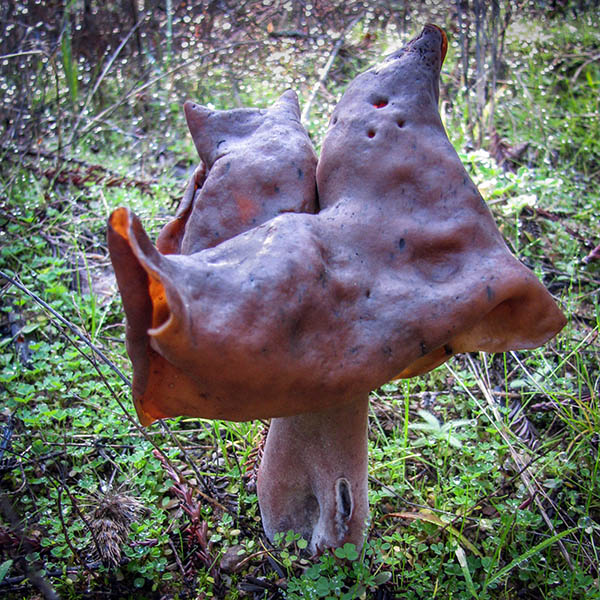
Gyromitra infula
Enchirdion fungorum in Europa media et praesertim in Gallia vigentium: 272. 1886.
Common Name: none
Synonym: Helvella infula Fries
Cap 3.0-8.0 cm tall, 3.0-9.0 cm broad, saddle-shaped, ie. two-lobed, occasionally 3 to 4 lobed, the tips usually well elevated above the stipe apex, fertile upper surface more or less glabrous, wavy to irregularly bumpy, but not wrinkled; margin curved toward the stipe and typically fused with it at several points; cap yellowish-brown, vinaceous-brown, to reddish-brown; lower cap surface paler, minutely tomentose; context, thin, brittle; odor and taste not distinctive.
Stipe 2.0-6.0 cm long, 1.0-2.5 cm thick, equal to enlarged at the base, stuffed or hollow, round to compressed, sometimes with a longitudinal fold, surface glabrous to subpubescent, the base often overgrown with whitish mycelium; stipe colored like the cap or lighter, i.e. various shades of brown from vinaceous-brown to reddish-brown, sometimes tinged lilac.
Spores 17-20 x 7-9 µm, ellipsoid-oblong, smooth, thin-walled, with 2 oil droplets.
Solitary to gregarious in conifer woods, occasional with hardwoods, fruiting on well-decayed wood, humus-rich soils, disturbed ground, or in burned areas; appearing in late fall in the Sierra, winter and spring along the coast.
 Potentially deadly, especially raw. This mushroom contains monomethylhydrazine. See comments about MMH under Gyromitra esculenta.
Of the several species of Gyromitra that occur in California, G. infula is the most easily recognized with a saddle-shaped, brown to reddish-brown cap and stipe. Like Gyromitra esculenta it contains monomethylhydrazine (MMH) and should be avoided. See "Comments" under Gyromitra esculenta for distinguishing features of that species, Gyromitra montana and Gyromitra californica. Gyromitra infula is mostly likely to be confused with saddle-shaped species of Helvella with smooth stipes. e.g. Helvella compressa and H. elastica. These species can be separated by their greyer caps and pallid stipes. If in doubt, a spore examination will confirm an identification, at least to genus. The spores of Gyromitras, including Gyromitra infula, have two oil droplets, while those of Helvellas have a single droplet.
Abbott, S.O. & Currah, R.S. (1997). The Helvellaceae: Systematic revision and occurrence in northern and northwestern North America. Mycotaxon 62: 1-125.
Ammirati, J.F., Traquair, J.A. & Horgen, P.A. (1985). Poisonous Mushrooms of the Northern United States and Canada. University of Minnesota Press: Minneapolis, MN. 396 p.
Arora, D. (1986). Mushrooms Demystified. Ten Speed Press: Berkeley, CA. 959 p.
Breitenbach, J. & Kränzlin, F. (1984). Fungi of Switzerland. Volume 1: Ascomycetes. Verlag Mykologia: Luzern, Switzerland. 310 p.
Castellano, M.A., Cázares, E., Fondrick, B. & Dreisbach, T. (2003). Handbook to additional fungal species of special concern in the Northwest Forest Plan (Gen. Tech Rep. PNW-GTR-572). U.S. Department of Agriculture, Forest Service, Pacific Northwest Research Station: Portland, OR. 144 p. (PDF)
Desjardin, D.E., Wood, M.G. & Stevens, F.A. (2015). California Mushrooms: The Comprehensive Identification Guide. Timber Press: Portland, OR. 560 p.
Duffy, T.J. (2008). Toxic Fungi of Western North America. MykoWeb.
Siegel, N. & Schwarz, C. (2016). Mushrooms of the Redwood Coast. Ten Speed Press: Berkeley, CA. 601 p.
Siegel, N., Mohatt, K. & Trudell, S. (2025). Mushrooms of Alaska. Timber Press: New York, NY. 572 p.
Smith, A.H. (1949). Mushrooms in their Natural Habitats. Sawyer's Inc: Portland, OR. 626 p. (PDF)
Tylutki, E.E. (1979). Mushrooms of Idaho and the Pacific Northwest: Discomycetes. University of Idaho Press: Moscow, ID. 133 p.
Weber, N.S. (1988). A Morel Hunter's companion. Two Penninsula Press: Lansing, MI. 288 p.