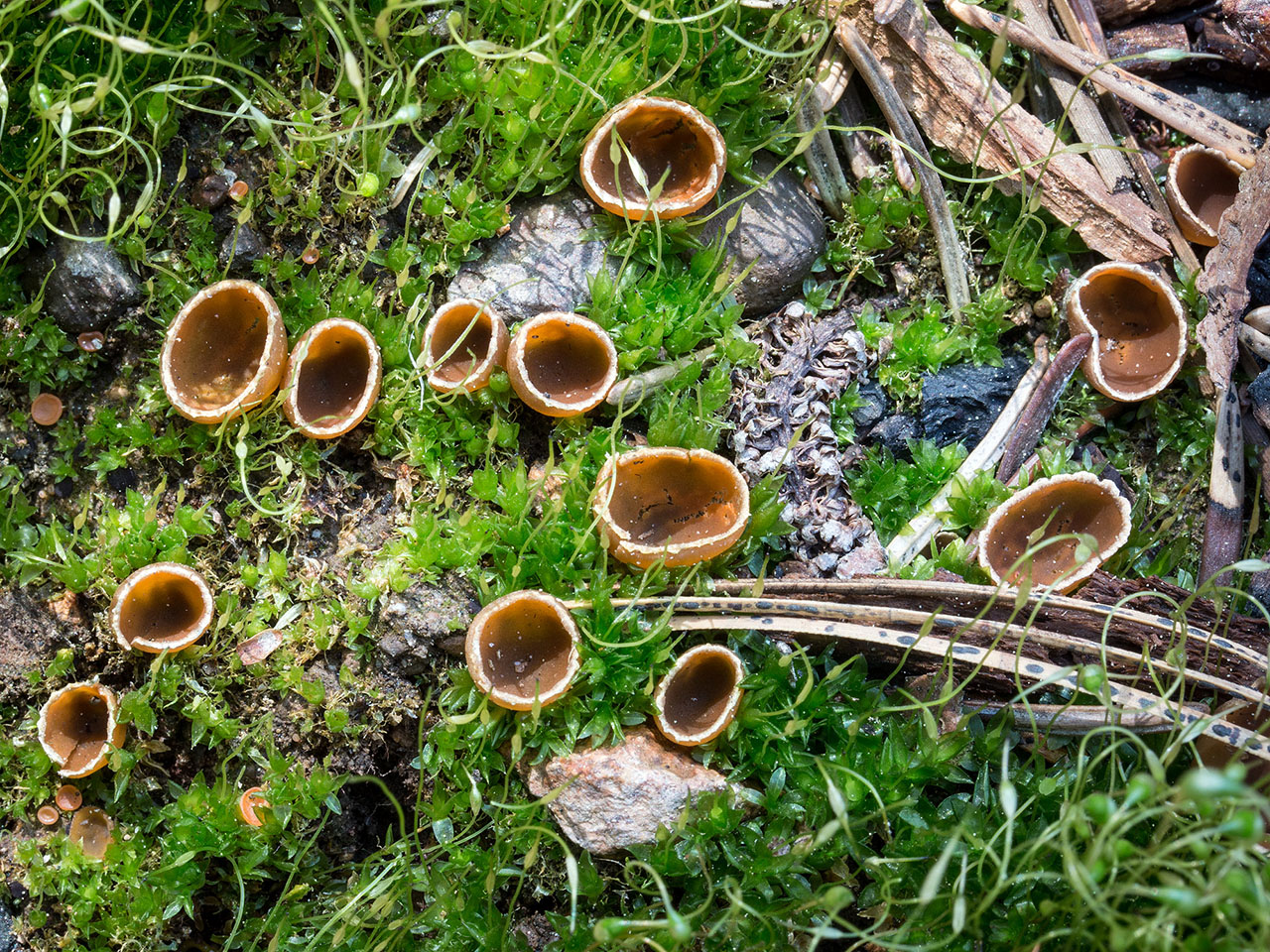
Geopyxis carbonaria
Sylloge Fungorum 8: 71. 1889.
Common Name: none
Synonym: Geopyxis vulcanalis (Peck) Sacc.
Fruiting body urn to goblet shaped; apothecia 0.5-1.5 cm broad, deeply cupulate, not expanding; margin pallid, crenate, incurved to upturned; fertile surface dull orange-brown to reddish-brown, glabrous; external surface glabrous, dull-brown, fading to pale-buff; stipe 0.3-1.0 cm long, 1.0-2.0 mm thick, straight to curved, the surface dull-brown covered with a white tomentum.
Spores 13.5-18.5 x 6.0-9.5 µm, ellipsoid, some narrowly so, a few oblong, smooth, thin-walled, eguttulate, contents granular; spore deposit not seen.
Gregarious to densely clustered on burnt soil or in campfire pits; fruiting during the spring in the Sierra Nevada and presumably also the coast ranges.
Ediblility unknown; insignificant.
A distinctive goblet shape, crenate cup margin, and habit of growing in burned soil are hallmarks of this attractive Ascomycete. It often fruits in vast numbers along with other fire-associated cup fungi like Pyronema omphalodes, Peziza violacea, P. pratervisa, Anthracobia macrocystis, and Plicaria endocarpoides. Geopyxis vulcanalis was once deemed a distinct species, but is now considered con-specific with Geopyxis carbonaria. What had been erroniously called Geopyxis vulcanalis in California is now properly called Geopyxis deceptiva.
Beug, M.W., Bessette, A.E. & Bessette, A.R. (2014). Ascomycete Fungi of North America. University of Texas Press: Austin, TX. 488 p.
Breitenbach, J. & Kränzlin, F. (1984). Fungi of Switzerland. Volume 1: Ascomycetes. Verlag Mykologia: Luzern, Switzerland. 310 p.
Dennis, R.W.G. (1981). British Ascomycetes. J. Cramer: Vaduz, Liechtenstein. 585 p.
Desjardin, D.E., Wood, M.G. & Stevens, F.A. (2015). California Mushrooms: The Comprehensive Identification Guide. Timber Press: Portland, OR. 560 p.
Greene, D.F., Hesketh, M. & Pounden, E. (2010). Emergence of morel (Morchella) and pixie cup (Geopyxis carbonaria) ascocarps in response to the intensity of forest floor combustion during a wildfire. Mycologia 102(4): 766-773.
Medardi, G. (2006). Ascomiceti d'Italia. Centro Studi Micologici: Trento. 454 p.
Seaver, F.J. (1978). The North American Cup-Fungi (Inoperculates). Lubrecht & Cramer: Monticello, N.Y. 428 p.
Siegel, N., Mohatt, K. & Trudell, S. (2025). Mushrooms of Alaska. Timber Press: New York, NY. 572 p.
Wang, X.-H. , Huhtinen, S. & Hansen, K. (2016). Multilocus phylogenetic and coalescent-based methods reveal dilemma in generic limits, cryptic species, and a prevalent intercontinental disjunct distribution in Geopyxis (Pyronemataceae s. l., Pezizomycetes). Mycologia 108(6): 1189-1215. (Abstract)