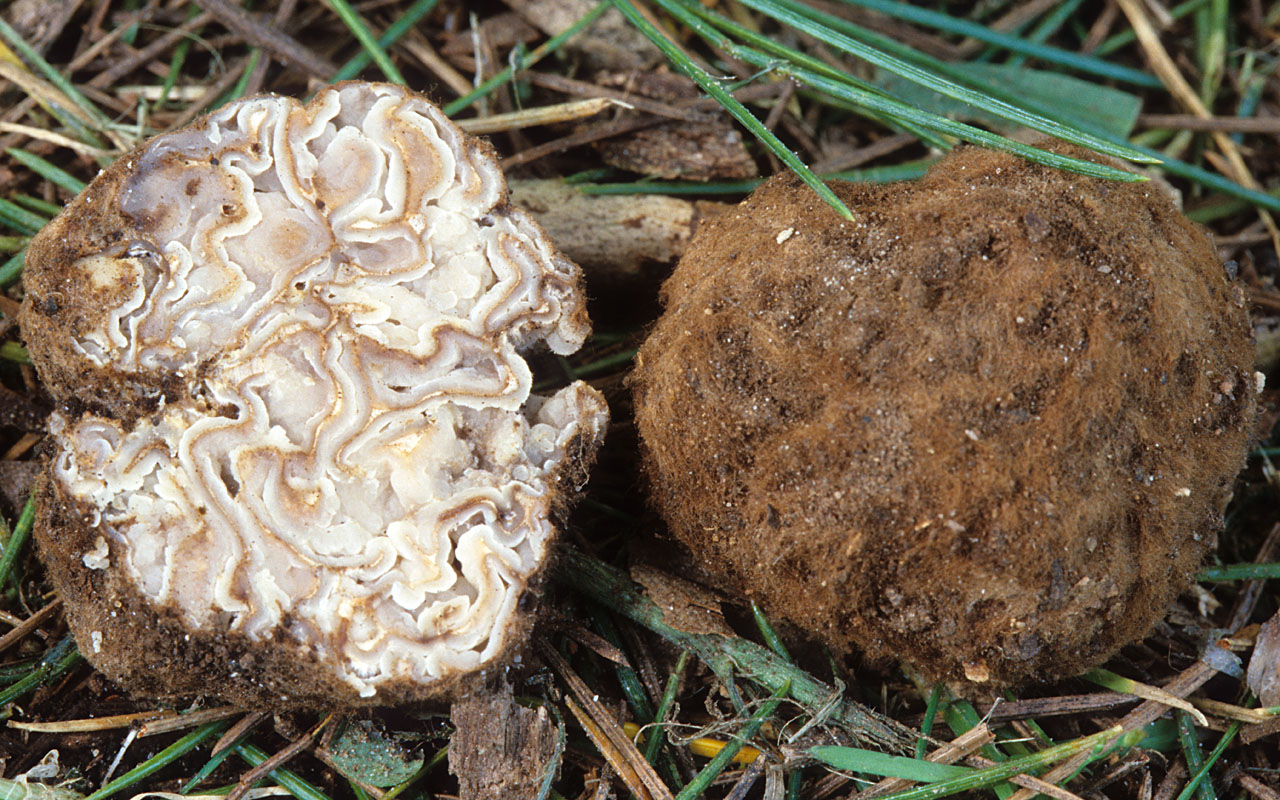
Geopora cooperi
Bull. Calif. Acad. Sci. 1:168. 1885.
Common Name: fuzzy truffle
Fruiting body 1.0-6.0 (10) cm broad, hypogeous, occasionally partially emergent, globose to somewhat pulvinate; surface convoluted to cerebreform, tan-brown to dark-brown, often finely warted, covered with coarse, mostly repent hairs (use hand-lens), the latter sometimes proliferating into the substrate; internal tissue labyrinthoid from infolding of the external surface, hymenial tissue whitish and pale-brown; odor faintly aromatic; taste mild.
Spores 19-25 x 13.5-16 µm, eight per ascus, uniserate, broadly elliptical, moderately thick-walled, smooth with granular contents and a central oil droplet.
In groups, mostly under conifers, hypogeous; fruiting from mid winter to early spring in coastal forests, late summer and fall in the Sierra Nevada (occasional in spring); associated with Monterey pine (Pinus radiata) and other conifers in the San Francisco Bay area, fairly common, but seldom collected.
 Edible.
Despite the common name, fuzzy truffle, Geopora cooperi is not closely related to the true truffles, i.e. Tuber species. A major difference is the spores which are smooth and forcibly discharged, while those of Tuber species are ornamented and not ejected from the ascus. Of the many truffle-like fungi in California, Geopora cooperi most closely resembles Hydnotrya cerebreformis which also has a pubescent exterior. The surface hairs of Hydnotrya cerebreformis, however, are very short and fine, not coarse. This species also differs in having a strong garlic odor and globose spores with rounded warts. Geopora cooperi f. gilkeyi differs from f. cooperi in having ovate to subglobose spores.
Arora, D. (1986). Mushrooms Demystified. Ten Speed Press: Berkeley, CA. 959 p.
Beug, M.W., Bessette, A.E. & Bessette, A.R. (2014). Ascomycete Fungi of North America. University of Texas Press: Austin, TX. 488 p.
Desjardin, D.E., Wood, M.G. & Stevens, F.A. (2015). California Mushrooms: The Comprehensive Identification Guide. Timber Press: Portland, OR. 560 p.
Harkness, H.W. (1899). Californian hypogeous fungi. Proc. Calif. Acad. Sci., ser 3 1: 241-292. (Protologue)
States, J.S. (1983). New records of hypogeous ascomycetes in Arizona. Mycotaxon 16: 396-402. (PDF)
Trappe, J.M., Molina, R., Luoma, D.L., Cázares, E., Pilz, D., Smith, J., Castellano, M.A., Miller, S.L. & Trappe, M.J. (2009). Diversity, Ecology, and Conservation of Truffle Fungi in Forests of the Pacific Northwest. U. S. Department of Agriculture, Forest Service, Pacific Northwest Research Station: Portland, OR. 194 p. (PDF)


