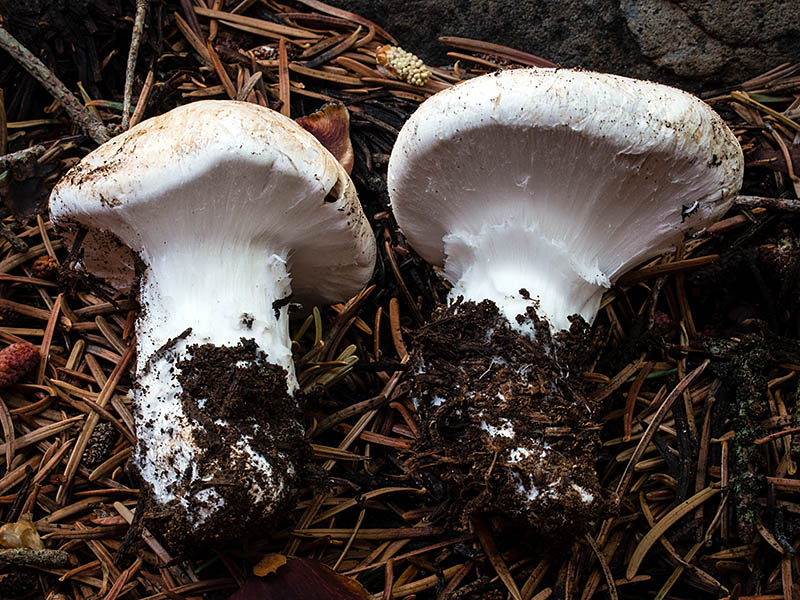
Cortinarius magnivelatus
Mycologia 86(6): 797. 1994.
Common Name: none
Synonyms: Pholiota magnivelata Morse (nomen nudum); Cortinarius magnivelatus (Morse) Thiers & Smith (nomen nudum)
Cap 4.0-8.0 cm broad, convex, broadly so in age; margin incurved, then decurved, frequently wavy; surface whitish to cream, dry, sparsely covered with appressed, brownish fibrils, bruising brownish and sometimes yellowish; context up to 2.0 cm, firm, white to buff, unchanging or slowly to tan-brown; odor and taste mild.
Gills adnexed, close, thin, broad, pallid when young, dark rusty-brown in age from maturing spores; lamellulae in three to four series.
Stipe 3.0-6.0 cm long, 1.5-3.0 cm thick, solid, equal to bulbous at the base; surface matted-tomentose, colored and bruising like the cap, the lower portion frequently dirt encrusted; partial veil fibrillose-membranous, white, persistent, remaining attached to the cap margin at maturity; in age spores released via radial tears in the partial veil.
Spores 10.0-13.5 x 5.5-7.0 µm, finely warted, elliptical to almond-shaped in face-view, inequilateral in profile, i.e. flattened on one side with an opposing belly, hilar appendage inconspicuous; spores dull rusty-brown in deposit.
Solitary to clustered, buried in duff of montane conifers; common in the spring, occasional in the fall.
Unknown.
This montane species recognized by a whitish cap, partial veil which remains attached to the cap at maturity, and tendency to fruit below ground. It is a common find of spring bolete hunters that unintentionally unearth it while seeking their more desirable quarry. Cortinarius verrucisporus is a less common relative that sometimes occurs with C. magnivelatus. It is distinguished by a yellow to tawny cap (at maturity) and yellowish partial veil. Smith and Thiers (1969) described several additional Cortinarii, all of which share the characteristics of a persistent veil and subsurface fruiting. These include Cortinarius wiebae with a whitish to tan-colored cap and fragile gills that are brownish even in youth; Cortinarius bigelowii, very short statured, with a tan cap and marginate, bulbous stipe; and Cortinarius velatus with a vinaceous to purple cap. None of these are common.
Arora, D. (1986). Mushrooms Demystified. Ten Speed Press: Berkeley, CA. 959 p.
Castellano, M.A., Smith, J.E., O'Dell, T., Cázares, E. & Nugent, S. (1999). Handbook to Strategy 1 Fungal Species in the Northwest Forest Plan. U. S. Department of Agriculture, Forest Service, Pacific Northwest Research Station: Portland, OR. 195 p. (PDF)
Desjardin, D.E., Wood, M.G. & Stevens, F.A. (2015). California Mushrooms: The Comprehensive Identification Guide. Timber Press: Portland, OR. 560 p.
Fogel, R. (1994). Materials for a Hypogeous Mycoflora of the Great Basin and Adjacent Cordilleras of the Western United States II. Two Subemergent Species Cortinarius saxamontanus, sp. nov., and C. magnivelatus, Plus Comments on Their Evolution. Mycologia 86: 795-801. (Protologue)
Morse, E.E. (1941). A new western Pholiota. Mycologia 33: 367-370.
Thiers, H.D. & Smith, A.H. (1969). Hypogeous Cortinarii. Mycologia 61: 526-536.


 — section
 — closeup section