Coprinus comatus
Tentamen Disp. Meth Fungorum: 62. 1797.
Common Name: shaggy mane
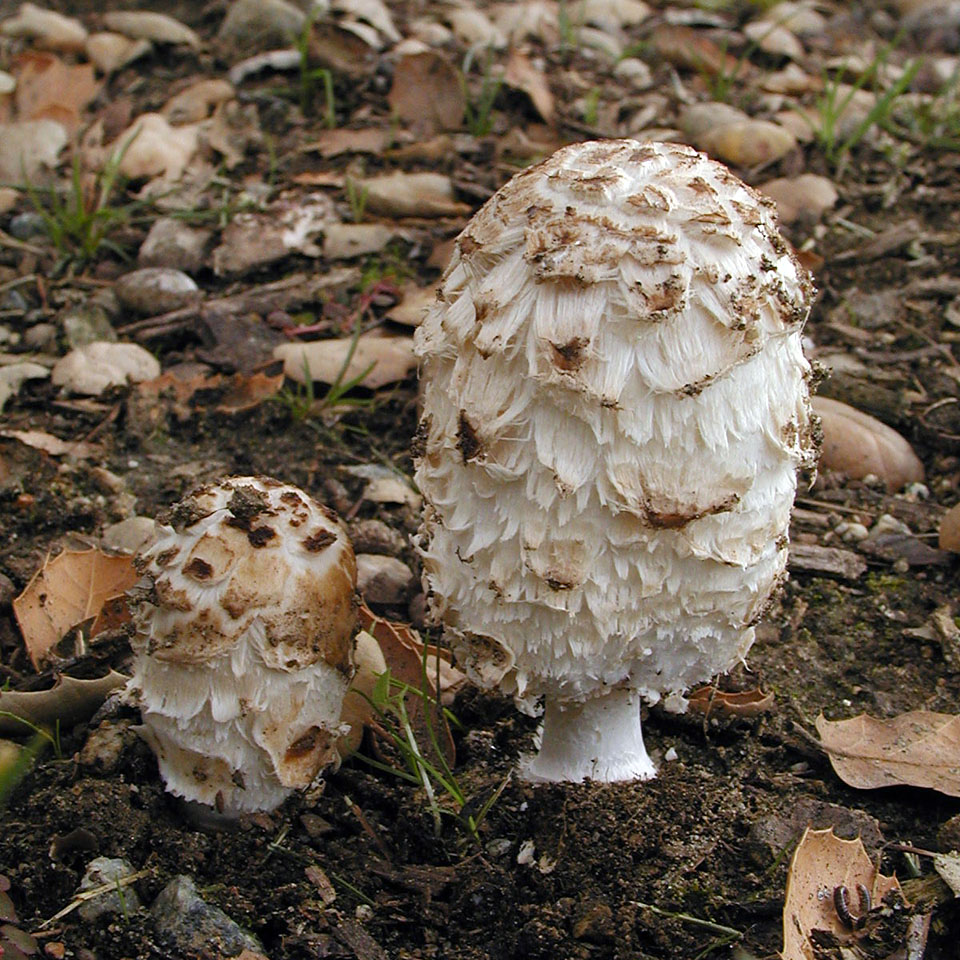
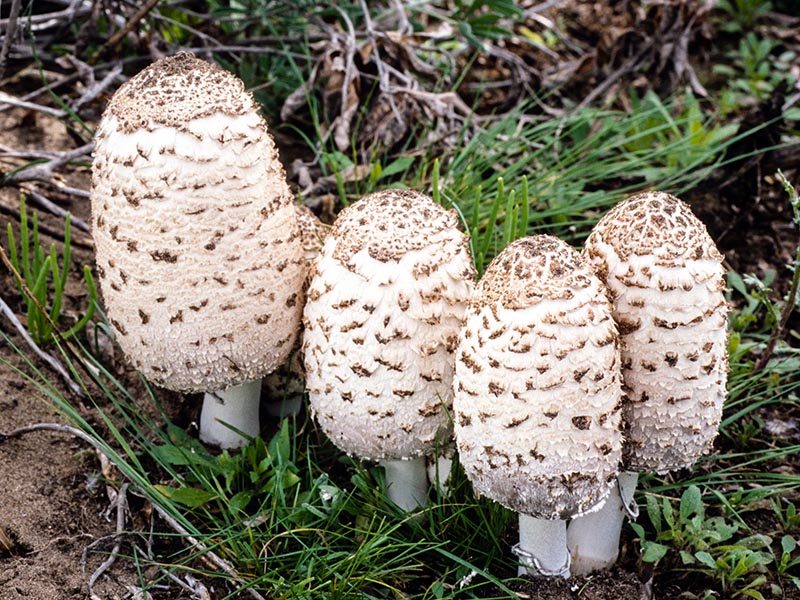
Cap 5-14 cm tall, 2.5-4.5 cm broad, columnar, becoming bell-shaped; surface dry, white with a brown central disc, breaking up into coarse, white and brown, recurved scales; flesh thin, white, and soft; odor and taste mild.
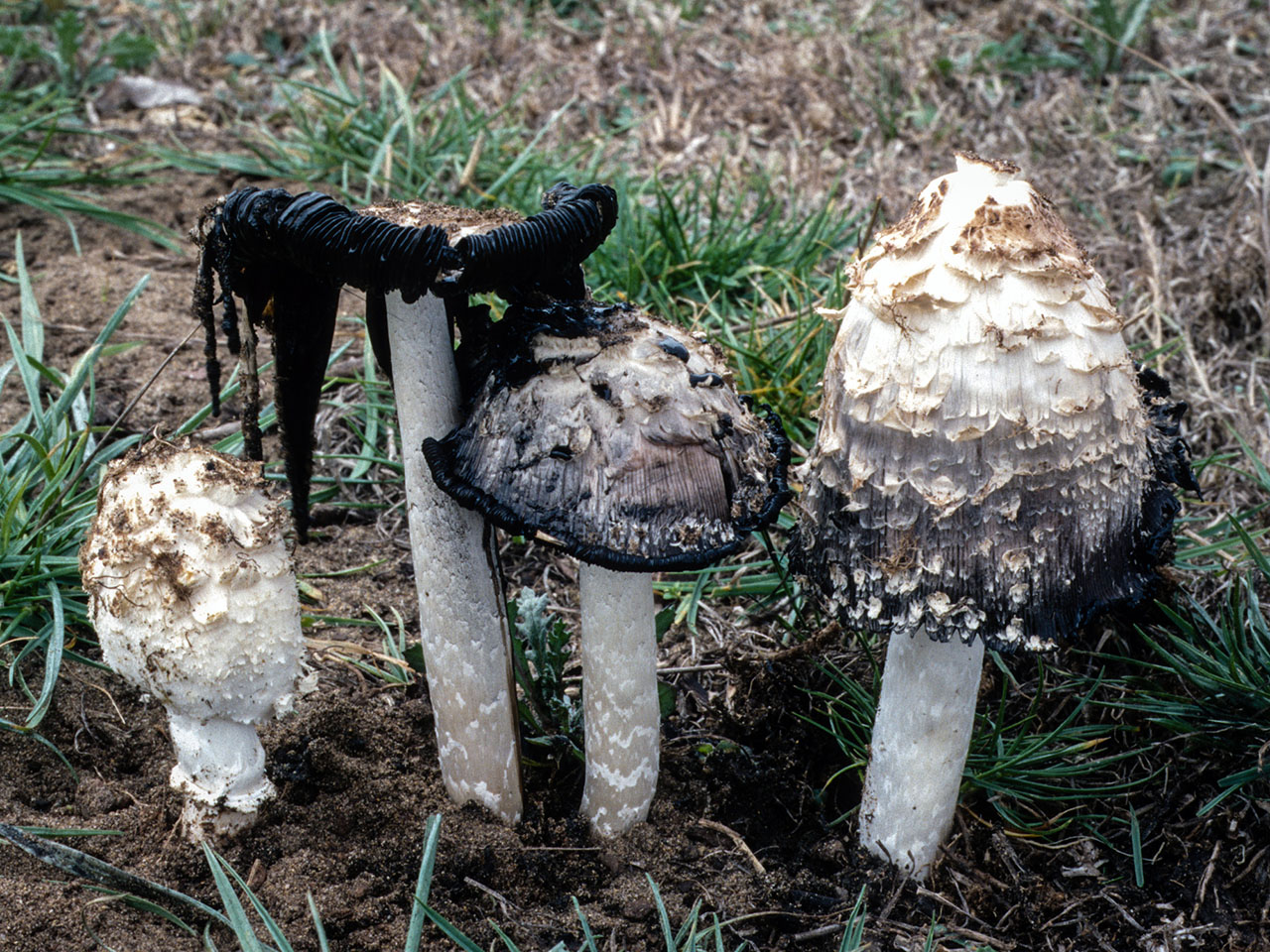
Gills adnexed to free, crowded, white, becoming pink, then deliquescing from the margin into a black, inky liquid.
Stipe 8-20 cm long, 1-1.5 cm thick, white, smooth, hollow, equal to bulbous at base, veil white, membranous, usually sliding to the bottom of the stipe.
Spores 12-16 x 7-8 µm, smooth, elliptical with an apical pore; spore print black.
Scattered, grouped, or in dense clusters on disturbed ground or grassy areas; found frequently along roadsides, paths and in playing fields; fruiting any month of the year when moisture is available but most abundant soon after the fall rains.
 Edible and choice, but must be cooked quickly before the caps turn to ink.
With its distinctive columnar, shaggy cap which dissolves into ink at maturity, Coprinus comatus is one of the easiest of all mushrooms to recognize. Coprinopsis atramentaria, another inky cap, is somewhat similar, but has a smooth to fibrillose, not scaly cap surface, and lacks the elongated cap shape of C. comatus.
Arora, D. (1986). Mushrooms Demystified. Ten Speed Press: Berkeley, CA. 959 p.
Bougher, N.L. & Syme, K. (1998). Fungi of Southern Australia. University of Western Australia Press: Nedlands, Australia. 391 p.
Breitenbach, J. & Kränzlin, F. (1995). Fungi of Switzerland. Volume 4: Agarics (2nd Part). Entolomataceae, Pluteaceae, Amanitaceae, Agaricaceae, Coprinaceae, Strophariaceae. Verlag Mykologia: Luzern, Switzerland. 368 p.
Desjardin, D.E., Wood, M.G. & Stevens, F.A. (2015). California Mushrooms: The Comprehensive Identification Guide. Timber Press: Portland, OR. 560 p.
Keirle, M.R., Hemmes, D.E. & Desjardin, D.E. (2004). Agaricales of the Hawaiian Islands. 8. Agaricaceae: Coprinus and Podaxis; Psathyrellaceae: Coprinopsis, Coprinellus and Parasola. Fungal Diversity 15: 33-124. (PDF)
Knudsen, H. & Vesterholt, J. ed. (2008). Funga Nordica: Agaricoid, boletoid and cyphelloid genera. Nordsvamp: Copenhagen, Denmark. 965 p. (PDF)
Knudsen, H. & Vesterholt, J. ed. (2012). Funga Nordica: Agaricoid, boletoid, clavarioid, cyphelloid and gastroid genera. Vol. 2. Nordsvamp: Copenhagen, Denmark. 572 p.
Noordeloos, M.E., Kuyper, T.W. & Vellinga, E.C. (2005). Flora Agaricina Neerlandica — Critical monographs on the families of agarics and boleti occurring in the Netherlands. Volume 6. Coprinaceae & Bolbitiaceae. Taylor & Francis: Boca Raton, FL. 227 p.
Orton, P.D. & Watling, R. (1979). British Fungus Flora: Agarics and Boleti. Vol 2. Coprinaceae: Coprinus. Royal Botanic Garden: Edinburgh, Scotland. 149 p.
Siegel, N. & Schwarz, C. (2016). Mushrooms of the Redwood Coast. Ten Speed Press: Berkeley, CA. 601 p.
Smith, A.H. (1949). Mushrooms in their Natural Habitats. Sawyer's Inc: Portland, OR. 626 p. (PDF)
Van de Bogart, F. (1976). The genus Coprinus in western North America, Part I: Section Coprinus. Mycotaxon 4(1): 233-275.


 —post deliquiscent
 — a fresh one