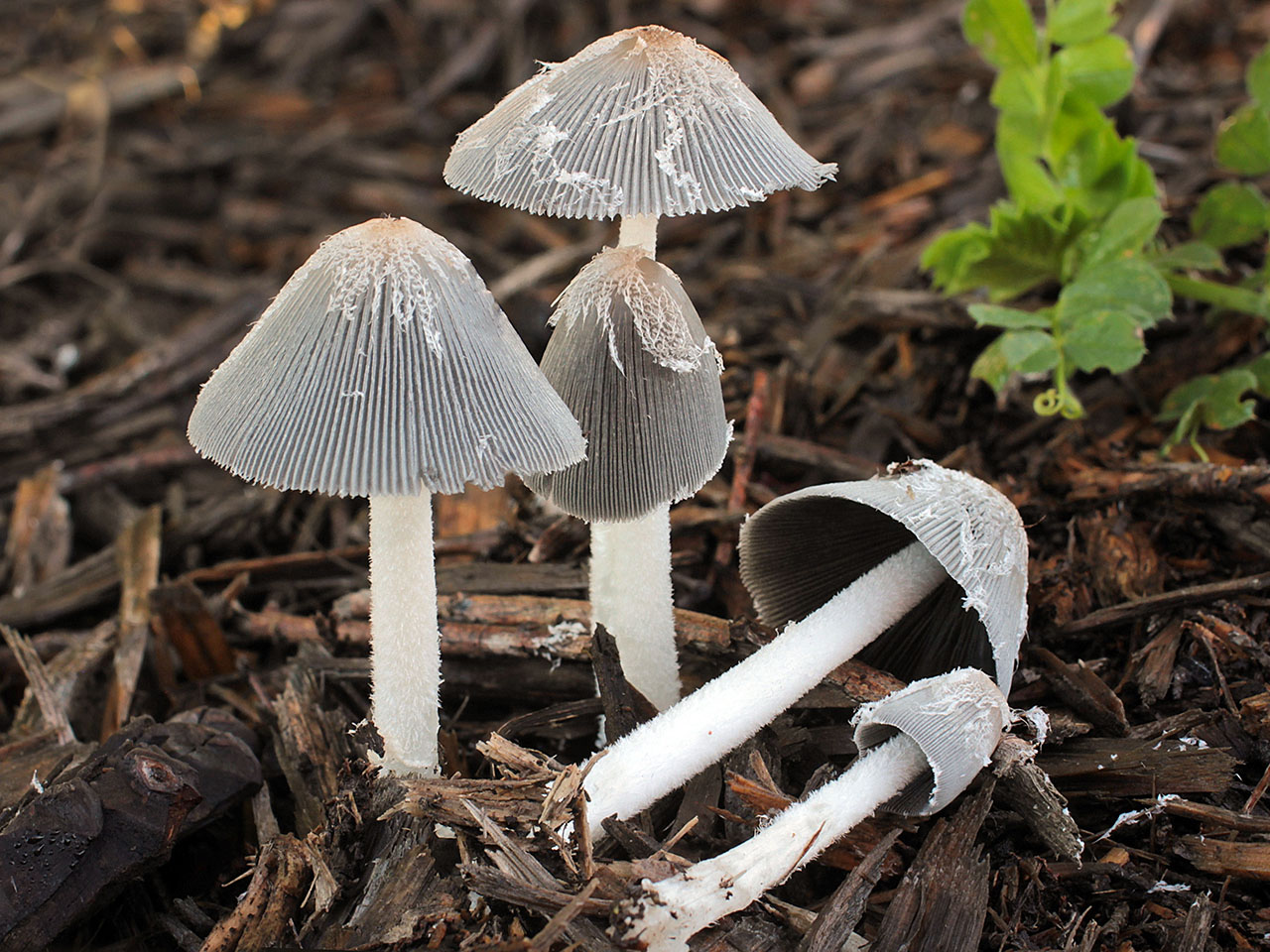
Coprinopsis lagopus
Epicr. Syst. Myc. 250. 1838.
Common Name: none
Synonym: Coprinus lagopus (Fries) Fries
Cap 3-6 cm broad, obtuse-conic, expanding to nearly plane, umbonate, the margin recurved in age, often split or ragged from deliquescing gills; surface at first covered with erect, soft, white hairs (universal veil remnants), typically weathering away at maturity to reveal a striate, greyish-brown cuticle; flesh thin, pale grey.
Gills free, close, narrow, white soon greyish, becoming black and deliquescing in moist weather.
Stipe 5-10 cm tall, 0.3-0.5 cm thick, more or less equal, fragile, hollow; surface dry, white tomentose from universal veil remnants; partial veil absent or evanescent.
Spores 11-13 x 6-8 µm, elliptical smooth; spore print black.
Scattered on logs, decaying wood etc.; fruiting from late fall to mid-winter.
Unknown.
This fragile, beautiful Coprinus with a revolute cap margin persists for only a few hours before senescing. The dense, erect, white hairs which cover the young fruiting body and the lignicolous habit help characterize this species.
Arora, D. (1986). Mushrooms Demystified. Ten Speed Press: Berkeley, CA. 959 p.
Breitenbach, J. & Kränzlin, F. (1995). Fungi of Switzerland. Volume 4: Agarics (2nd Part). Entolomataceae, Pluteaceae, Amanitaceae, Agaricaceae, Coprinaceae, Strophariaceae. Verlag Mykologia: Luzern, Switzerland. 368 p.
Desjardin, D.E., Wood, M.G. & Stevens, F.A. (2015). California Mushrooms: The Comprehensive Identification Guide. Timber Press: Portland, OR. 560 p.
Keirle, M.R., Hemmes, D.E. & Desjardin, D.E. (2004). Agaricales of the Hawaiian Islands. 8. Agaricaceae: Coprinus and Podaxis; Psathyrellaceae: Coprinopsis, Coprinellus and Parasola. Fungal Diversity 15: 33-124. (PDF)
Knudsen, H. & Vesterholt, J. ed. (2008). Funga Nordica: Agaricoid, boletoid and cyphelloid genera. 965 p.
Noordeloos, M.E., Kuyper, T.W. & Vellinga, E.C. (2005). Flora Agaricina Neerlandica—Critical monographs on the families of agarics and boleti occurring in the Netherlands. Volume 6. Coprinaceae & Bolbitiaceae. Taylor & Francis: Boca Raton, FL. 227 p.
Orton, P.D. & Watling, R. (1979). British Fungus Flora: Agarics and Boleti. Vol 2. Coprinaceae: Coprinus. Royal Botanic Garden: Edinburgh, Scotland. 149 p.
Siegel, N. & Schwarz, C. (2016). Mushrooms of the Redwood Coast. Ten Speed Press: Berkeley, CA. 601 p.
Siegel, N., Mohatt, K. & Trudell, S. (2025). Mushrooms of Alaska. Timber Press: New York, NY. 572 p.


