Caloscypha fulgens
Bull. Soc. mycol. Fr. 1: 103. 1885.
Common Name: none
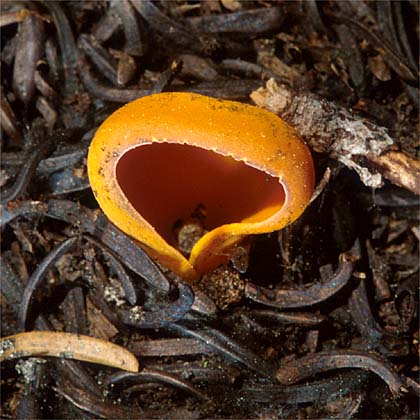
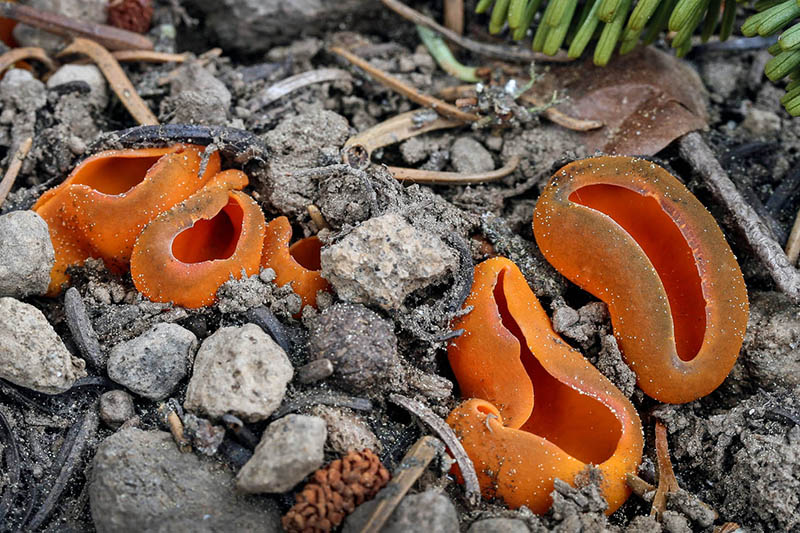
Fruiting body 0.5-3.5 (5.0) cm broad, cupulate, elongate, to variously lobed, sometimes nearly flat in age, sessile to short stipitate; margin incurved, then straight, even to eroded; exterior surface dull yellow to yellowish-orange, bruising bluish-green to olive, especially near the margin; hymenial surface yellow-orange to orange, glabrous.
Spores 5.5-7.5 µm, globose, smooth, hyaline; spores whitish in deposit.
Scattered, gregarious to clustered on needle mats during the spring in the Sierra and higher elevations of the Coast Range; common in most years.
Unknown; insignificant.
A snowbank fungus, Caloscypha fulgens is distinguished by its yellowish-orange, variously-shaped cups which discolor bluish-green with handling or age. It resembles Aleuria aurantia, the Orange Peel Fungus, but the latter lacks a bluing reaction and typically fruits in the fall. White forms, but still bluing, are occasionally encountered. This is one of a number of Ascomycetes used by morel hunters as an indicator species.
Arora, D. (1986). Mushrooms Demystified. Ten Speed Press: Berkeley, CA. 959 p.
Beug, M.W., Bessette, A.E. & Bessette, A.R. (2014). Ascomycete Fungi of North America. University of Texas Press: Austin, TX. 488 p.
Breitenbach, J. & Kränzlin, F. (1984). Fungi of Switzerland. Volume 1: Ascomycetes. Verlag Mykologia: Luzern, Switzerland. 310 p.
Dennis, R. W. G. (1981). British Ascomycetes. J. Cramer: Vaduz, Liechtenstein. 585 p.
Desjardin, D.E., Wood, M.G. & Stevens, F.A. (2015). California Mushrooms: The Comprehensive Identification Guide. Timber Press: Portland, OR. 560 p.
Dougoud, R. (2014). Apports à la connaissance de Caloscypha fulgens (Pezizales). Ascomycete.org 6(1): 5-10. (PDF)
Medardi, G. (2006). Ascomiceti d'Italia. Centro Studi Micologici: Trento. 454 p.
Smith, A.H. (1949). Mushrooms in their Natural Habitats. Sawyer's Inc: Portland, OR. 626 p. (PDF)
Tylutki, E.E. (1979). Mushrooms of Idaho and the Pacific Northwest: Discomycetes. University of Idaho Press: Moscow, ID. 133 p.