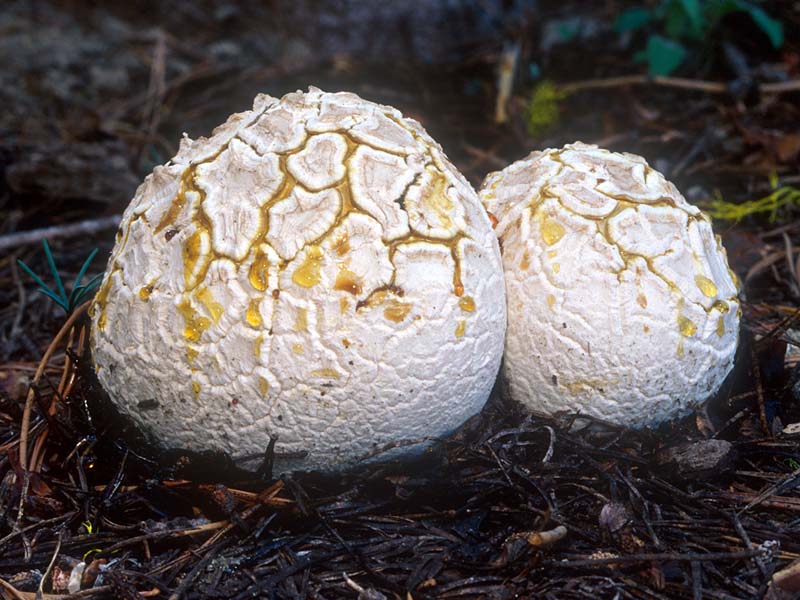
Calbovista subsculpta
Mycotaxon 54:390. 1995.
Common Name: Puffball
Fruiting body 7.0-13.0 cm broad, up to 10 cm tall, subglobose to compressed-turbinate, the lower quarter composed of sterile tissue, the base attached to the substrate via a root-like mycelial cord; exoperidium surface felty to matted-tomentose, covered with broad, low polygonal warts up to 1.5 cm wide and 0.5 cm tall, the tips rounded to truncate; color: cream to pale-ochre, sometimes developing tawny areas; endoperidium thin, membranous, persistent with the exoperidium and usually falling away with it; peridium opening by cracks formed at the base of the warts, or the fruiting body apex peeling back to form a broad cavity; gleba white to cream, becoming ochre to olivaceous, finally medium-brown, sometimes tinged purplish, powdery; odor and taste untried. subgleba of finely-textured, cream-colored cells becoming buff to light-brown in age.
Spores 3.5-5.0 µm in diameter, globose, sub-globose, to occasionally ovate, smooth to finely warted, moderately thick-walled, most with a central oil-drople and a stub-like, hyaline pedicel; capillitium consisting of discrete elements, i.e. not interwoven, each unit compactly branched with pointed lateral stubs; pits absent.
Solitary, scattered, or in small groups along dirt roads, trails or open areas in conifer woods; found at mid to higher elevations of the Sierra Nevada and Coast Range; fruiting during the spring; common in most years.
 Edible when young and the gleba still white.
Calbovista subsculpta is a montane species recognized by its grapefruit-size sporocarps with broad low, felty warts, and a root-like soil attachment. It is sometimes confused with the striking, but less common Calvatia sculpta. The latter, when young is easily distinguished by large hooked warts, while older specimens can be separated by their more erect stature, usually with a distinct "pseudostipe," terraced warts, and lack of a rooted base. Both species are edible, though not choice.
Desjardin, D.E., Wood, M.G. & Stevens, F.A. (2015). California Mushrooms: The Comprehensive Identification Guide. Timber Press: Portland, OR. 560 p.
Jarvis, S.S. (2014). The Lycoperdaceae of California. Masters thesis. San Francisco State University: San Francisco, CA. 336 p.
Morse, E.E. (1935). A New Puffball. Mycologia 27(2): 96-101.
Seidl, M.T. (1995). Validation of the Puffball Genus Calbovista. Mycotaxon 54: 389-392.
Smith, A.H. (1949). Mushrooms in their Natural Habitats. Sawyer's Inc: Portland, OR. 626 p. (PDF)