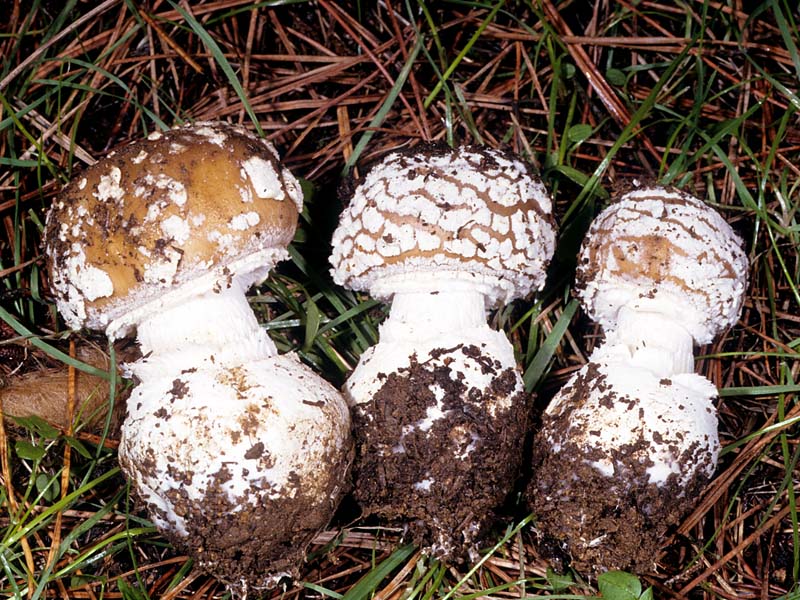
Amanita pantherina
Abbild. 4: Pl. 29. 1936.
Common Name: Panther
Cap 4-15 cm broad, convex at first, then plane in age, viscid, margin striate; color variable: from buff-yellow (usually darker at the disc) to dark brown; universal veil remnants forming pointed warts. Odor mild.
Gills adnexed to free, white to cream, close.
Stipe 7-11 cm long, 1-2.5 cm, tapering to a basal bulb. Partial veil membranous leaving a superior skirt-like ring. Universal veil forming a single roll or collar on the basal bulb.
Spores 9.5-13 x 7-9.5 µm, smooth, elliptical, nonamyloid. Spore print white.
Scattered to gregarious under pine, especially Monterey pine from midwinter to spring. Because Monterey pine is widely planted in the San Francisco Bay area, the Panther Amanita is abundant and easily found in urban parks.
 Toxic, but normally not deadly. Contains ibotenic acid and muscimol.
Amanita pantherina is an extremely variable species in the S.F. Bay area with cap color varying from yellowish-buff to dark brown. Most collections fall in the former category. Amanita gemmata is similar but with a yellower cap. There is speculation (but probably not true) that the two species hybridize locally causing the variation that is seen.
Amanita pantherina is likely a species complexe and the true Amanita pantherina probably does not occur in North America.
Ammirati, J.F., Traquair, J.A. & Horgen, P.A. (1985). Poisonous Mushrooms of the Northern United States and Canada. University of Minnesota Press: Minneapolis, MN. 396 p.
Arora, D. (1986). Mushrooms Demystified. Ten Speed Press: Berkeley, CA. 959 p.
Benjamin, D.R. (1995). Mushrooms: Poisons and Panaceas. W. H. Freeman: New York, NY. 422 p.
Bunyard, B.A. & Justice, J. (2020). Amanitas of North America. The Fungi Press: Batavia, IL. 336 p.
Desjardin, D.E., Wood, M.G. & Stevens, F.A. (2015). California Mushrooms: The Comprehensive Identification Guide. Timber Press: Portland, OR. 560 p.
Duffy, T.J. (2008). Toxic Fungi of Western North America. MykoWeb.
Hotson, J.W. & Lewis, E. (1934). Amanita pantherina of Western Washington. Mycologia 26(5): 384-391.
Jenkins, D.T. (1986). Amanita of North America. Mad River Press: Eureka, CA. 197 p.
Knudsen, H. & Vesterholt, J. ed. (2008). Funga Nordica: Agaricoid, boletoid and cyphelloid genera. Nordsvamp: Copenhagen, Denmark. 965 p. (PDF)
Knudsen, H. & Vesterholt, J. ed. (2012). Funga Nordica: Agaricoid, boletoid, clavarioid, cyphelloid and gastroid genera. Vol. 1. Nordsvamp: Copenhagen, Denmark. 511 p.
Siegel, N. & Schwarz, C. (2016). Mushrooms of the Redwood Coast. Ten Speed Press: Berkeley, CA. 601 p.
Smith, A.H. (1949). Mushrooms in their Natural Habitats. Sawyer's Inc: Portland, OR. 626 p. (PDF)
Spoerke, D.G. & Rumack, B.H. (1994). Handbook of Mushroom Poisoning: Diagnosis and Treatment. CRC Press: Boca Raton, FL. 456 p.
Thiers, Harry D. (1982). The Agaricales (Gilled Fungi) of California. 1. Amanitaceae. Mad River Press: Eureka, CA. 53 p.