
Agaricus sylvicola
Ann. Rep. Reg. St. N.Y. 23: 97. 1872.
Common Name: none
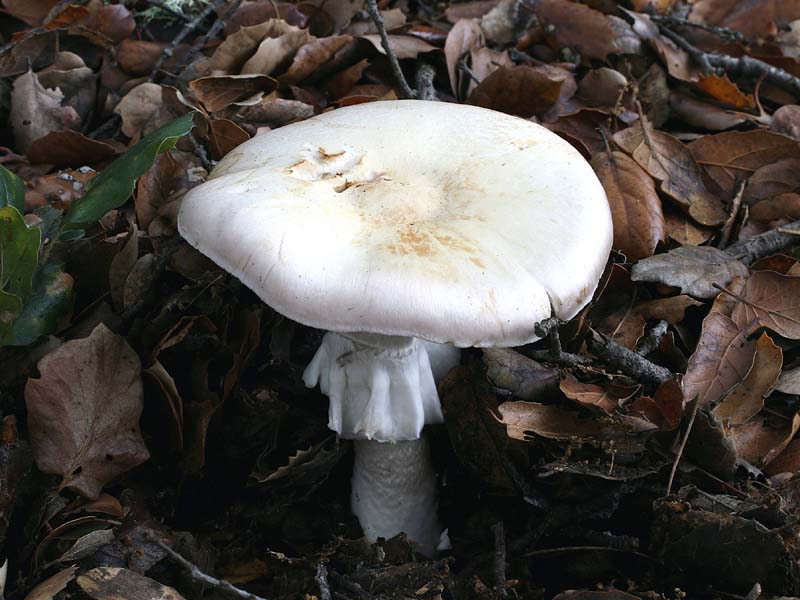
Cap 6.0-12.0 cm broad, globose to deeply convex, becoming convex to plano-convex at maturity; margin incurved, then decurved, eventually straight; surface dry, white, glabrous to innately fibrillose, in dry weather sometimes squamulose; yellowing slowly when bruised or with age, yellow with KOH; context firm, white, unchanging, up to 1.5 cm thick; odor of anise or almonds; taste mild.
Gills free, close to crowded, moderately broad, pallid in youth, blackish-brown in age; edges lighter than the faces.
Stipe 6.0-12.0 cm long, 1.5-2.0 cm thick, equal, clavate, sometimes bulbous, hollow to stuffed; surface of apex whitish, fibrillose-striate, lower stipe colored like above, more or less glabrous, stipe base slowly bruising yellowish to tawny; context white unchanging; veil double, the lower surface white, matted-tomentose, splitting radially in cogwheel fashion revealing a similarly textured often fissured under-layer; annulus white, thin, the margin blunt, pendulous, attached high on the stipe.
Spores 5.5-6.5 x 3.5-4.0 µm, ellipsoid, smooth, moderately thick-walled; hilar appendage conspicuous; spore print blackish-brown.
Solitary or in small groups in mixed hardwood-conifer forests; fruiting from late fall to mid-winter; uncommon.
 Edible and excellent, although some may be sensitive to it. See "Comments".
This forest-dweller is recognized by a white cap which yellows slowly when bruised and an anise/almond odor. It is believed to be part of a group of closely related, but hard to distinguish species. One of these is Agaricus albolutescens, a shorter, stockier mushroom with a white cap and strong yellowing reaction when bruised. For several reasons, Agaricus sylvicola and its relatives are not recommended to beginners for the table. Besides the occasional adverse reactions that have been reported, it bears a close resemblance to Agaricus xanthodermus, a toxic though not dangerously poisonous species. Like Agaricus sylvicola, it may have a nearly white cap, but can be separated by a phenolic odor and stipe base that yellows quickly when bruised. A potentially far more serious problem for the inexperienced mycophagist is the possibility of confusion with the white form of Amanita phalloides, the Death Cap. See the Amanita phalloides description for details.
This species is often misspelled as Agaricus silvicola.
Ammirati, J.F., Traquair, J.A. & Horgen, P.A. (1985). Poisonous Mushrooms of the Northern United States and Canada. University of Minnesota Press: Minneapolis, MN. 396 p.
Arora, D. (1986). Mushrooms Demystified. Ten Speed Press: Berkeley, CA. 959 p.
Breitenbach, J. & Kränzlin, F. (1995). Fungi of Switzerland. Volume 4: Agarics (2nd Part). Entolomataceae, Pluteaceae, Amanitaceae, Agaricaceae, Coprinaceae, Strophariaceae. Verlag Mykologia: Luzern, Switzerland. 368 p.
Desjardin, D.E., Wood, M.G. & Stevens, F.A. (2015). California Mushrooms: The Comprehensive Identification Guide. Timber Press: Portland, OR. 560 p.
Kerrigan, R.W. (1986). The Agaricales (Gilled Fungi) of California. 6. Agaricaceae. Mad River Press: Eureka, CA. 62 p.
Kerrigan, R.W. (2016). Agaricus of North America. New York Botanical Garden: Bronx, NY. 574 p.
Knudsen, H. & Vesterholt, J. ed. (2008). Funga Nordica: Agaricoid, boletoid and cyphelloid genera. Nordsvamp: Copenhagen, Denmark. 965 p. (PDF)
Knudsen, H. & Vesterholt, J. ed. (2012). Funga Nordica: Agaricoid, boletoid, clavarioid, cyphelloid and gastroid genera. Vol. 2. Nordsvamp: Copenhagen, Denmark. 572 p.
Peck, C.H. (1883). Report of the State Botanist 1882. Ann. Rep. NY State Mus. 36: 27-49.
Sánchez, L.A.P. (2013). Agaricus L.; Allopsalliota Nauta & Bas; Part 2. Edizioni Candusso: Alassio, Italy. 1168 p.
Siegel, N., Mohatt, K. & Trudell, S. (2025). Mushrooms of Alaska. Timber Press: New York, NY. 572 p.
Smith, A.H. (1949). Mushrooms in their Natural Habitats. Sawyer's Inc: Portland, OR. 626 p. (PDF)




.jpg)